
How to Find a Reliable GRG Contractor in Dubai
If you are searching for GRG contractors near you in Dubai, here is what every qualified professional in this field will confirm before anything else – the most important step is not simply finding a contractor. It is verifying the right one.
A trustworthy GRG contractor in Dubai must clear five checkpoints before you commit to anything:
- They manufacture Glass Reinforced Gypsum in their own UAE-based facility – not through a subcontractor you have never met or inspected.
- They hold UAE Civil Defence approval and can produce valid fire test certificates for the exact material being supplied to your project.
- Their portfolio includes completed UAE projects that are similar in type and complexity to yours – not just photographs on a phone.
- They operate an in-house mold manufacturing shop and are willing to let you visit it at any time.
- They offer a free site assessment and provide a fully itemised quotation – not a vague lump-sum figure with no breakdown.
Skip any one of those five checkpoints and you are accepting a level of risk that could cost significantly more than the original project value to resolve.
Why Hiring a GRG Contractor in Dubai Requires More Careful Thought Than Most People Expect
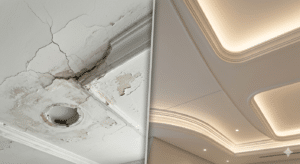
Dubai’s interior fit-out market was valued at USD 3.08 billion in 2024 and is forecast to reach USD 4.13 billion by 2030 at a CAGR of 4.85%, according to ResearchAndMarkets. Dubai alone accounted for 41.6% of all UAE construction activity in 2024, per Mordor Intelligence – concentrated precisely in the sectors where GRG is most commonly specified: luxury hospitality, high-end residential, mosques, and government buildings.
That level of demand has attracted a large and growing number of contractors who use the right terminology but do not have the factory capability, material knowledge, or compliance documentation to back it up.
Here is a situation that plays out more frequently than the industry acknowledges:
- A villa owner in Jumeirah commissions a custom GRG dome ceiling.
- The contractor comes in 20% below the other quotes, starts quickly, and finishes on time.
- Eight months later, hairline cracks run across the panel joints.
- The paint begins separating from the surface beneath.
- A consultant is brought in and confirms the contractor used beta gypsum instead of the required high-density alpha gypsum – and holds no UAE Civil Defence fire certificate for the material.
- The remediation bill exceeds the original contract value by 40%.
This guide gives you a professional hiring framework that prevents that outcome. It covers:
- What GRG is and why it behaves differently from GRC and GRP.
- The five types of GRG projects in Dubai and how they differ in complexity.
- Seven vetting criteria that identify a genuinely qualified contractor.
- Eight red flags that should end the conversation immediately.
- How GRG pricing is structured and why the cheapest quote is typically the costliest outcome.
- A step-by-step installation process guide written from the client’s perspective.
- Short, direct answers to the questions Dubai clients ask most often.
What Is GRG? The Material Powering Dubai’s Most Impressive Interiors
Understanding Glass Reinforced Gypsum From the Ground Up
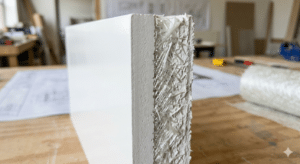
Glass Reinforced Gypsum (GRG) is a factory-manufactured composite material built from two core raw materials:
- High-density alpha gypsum – the structural base, naturally non-combustible due to its chemically bound water content.
- Alkali-resistant continuous strand glass fibre mats – the reinforcement that gives the panels their strength, flexibility, and impact resistance.
During production, these two materials are hand-laminated into a mold in alternating layers – gypsum, fibre, gypsum, fibre – until the panel reaches the required thickness. Standard panel thickness in Dubai projects ranges from 10mm for lightweight ceiling applications to 20mm for heavier decorative elements such as dome segments or column cladding. The cast element cures, is removed from the mold, quality-checked, and prepared for delivery.
If you want to explore the full material science behind GRG – including how alpha gypsum differs from standard gypsum and why it performs differently under heat and load – the GRG material page at Al Jilani GRC covers this in detail for both technical and non-technical readers.
Six Properties That Make GRG the Standard Specification for Dubai Interiors
- Lightweight construction. GRG panels are dramatically lighter than traditional plaster or precast concrete equivalents. This reduces structural load on suspended ceiling framing and simplifies the logistics of transporting and handling large-format elements on busy construction sites.
- Non-combustible classification. When manufactured from high-density alpha gypsum, GRG is inherently non-combustible. Gypsum contains approximately 21% chemically bound water by weight, which converts to steam under heat – absorbing thermal energy and actively retarding fire spread. This is a fundamental material property, not a surface treatment or additive.
- Exceptional moldability. GRG can be cast into virtually any geometric form with factory-level precision and repeatability:
- Compound-curve domes.
- Arabesque surface panels.
- Calligraphic ceiling medallions.
- Muqarnas-style vaulting.
- Classical cornices and column capitals.
- Dimensional stability in Dubai’s climate. GRG resists humidity-induced expansion and contraction – critical in Dubai, where interior spaces cycle between heavily air-conditioned environments and high external ambient humidity throughout the year.
- Paint-ready surface finish. GRG emerges from its mold with a consistently smooth face that requires minimal surface preparation before painting, reducing both finishing time and material cost compared to site-applied plasterwork.
- Structural efficiency for large-scale work. Factory-produced GRG panels install faster and more predictably than hand-applied plasterwork – with no wet-trade curing delays, no scaffolding-intensive plastering programmes, and no quality variation between panels from the same production run.
GRG vs. GRC vs. GRP in Dubai – A Comparison Every Client Must Read Before Hiring

This is where the majority of hiring mistakes begin – not during installation, but during the initial contractor selection conversation. The abbreviations GRG, GRC, and GRP appear on quotations and contractor websites throughout Dubai. They look similar. They are not the same material.
These are three entirely different materials with different base compositions, physical properties, applications, and regulatory classifications.
| Property | GRG | GRC | GRP |
| Full Name | Glass Reinforced Gypsum | Glass Reinforced Concrete | Glass Reinforced Polyester |
| Base Material | Alpha gypsum | Portland cement | Polyester resin |
| Application Zone | Interior only | Exterior cladding | Interior or exterior functional |
| Fire Classification | Non-combustible | Non-combustible | Combustible – varies by resin |
| Weight | Very light | Medium to heavy | Light to medium |
| Surface Finish | Smooth, paint-ready | Textured or raw | Variable |
| Water Resistance | None – degrades with moisture | Good | Excellent |
| Typical Dubai Use | Domes, cornices, ceiling panels, columns | Façade cladding, screens, external panels | Water tanks, ducts, canopies |
What this means for your hiring decision:
- Never use GRG in any area exposed to moisture, humidity, or external weather – it will deteriorate rapidly because gypsum is water-soluble.
- If your project includes both interior GRG work and exterior GRC or GRP elements, a specialist that handles all three – such as Al Jilani GRC’s full product range – gives you a single accountable partner across the whole scope.
- A contractor who uses “GRG” and “GRC” interchangeably in conversation has already demonstrated that they lack the material knowledge to do this work correctly.
To understand the specific differences between GRC and GRP and when each is the right specification for your project, those dedicated pages provide detailed technical breakdowns.
Types of GRG Projects in Dubai – Identifying Your Category Before You Search
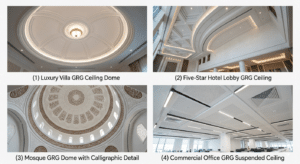
GRG spans a wider range of applications than most clients realise. The complexity, required documentation, timeline expectations, and ideal contractor profile all differ meaningfully between these categories.
Luxury Residential GRG Projects in Dubai
Who this applies to: Villa owners, penthouse developers, interior designers working on private residential projects.
Common GRG applications in luxury residential work:
- Custom ceiling domes in master bedrooms, formal living rooms, and entrance halls.
- Ornate cornices scaled precisely to room proportions and ceiling heights.
- Decorative wall panel features in entrance lobbies and majlis spaces.
- Column cladding with detailed capital and base elements.
- Ceiling medallions and coffers for chandelier installations.
What makes residential GRG work distinct: Residential projects demand the highest level of individual customisation. The contractor must have genuine in-house mold-making capability – standard catalog profiles will not achieve the bespoke results that Dubai villa owners and their interior designers typically require.
Five-Star Hospitality GRG Projects
Who this applies to: Hotel developers, fit-out consultants, hospitality project managers.
Common GRG applications in hospitality projects:
- Grand lobby ceiling systems spanning large column-free areas.
- Ballroom and function room feature ceilings, wall surrounds, and ceiling coffers.
- Ornamental column surrounds in restaurant, spa, and reception areas.
- Decorative ceiling elements along full-length guest corridors.
- Bespoke feature walls in suites and VIP areas.
What separates hospitality work from residential work: Hotel renovation projects frequently operate while partial hotel operations continue. This creates narrow access windows, strict noise restrictions, and multi-trade coordination constraints that require genuine operational experience in live hospitality environments – not just technical GRG knowledge.
Mosque and Religious Building GRG Projects
Who this applies to: Islamic architecture consultants, mosque committees, government religious building departments.
Common GRG applications in mosque projects:
- Large-span dome systems using segmented GRG panel construction.
- Mihrab surrounds with intricate calligraphic or geometric surface carving.
- Muqarnas-style vaulted ceiling systems.
- Perimeter cornice and frieze systems with Quranic text.
- Decorative column capitals and base elements with Islamic geometric patterns.
What distinguishes mosque work: Portfolio review must include examples of comparable religious projects – not simply general interior work. Geometric precision, cultural accuracy, and structural engineering for large-span dome systems are distinct disciplines from standard ceiling installation.
Commercial and Institutional GRG Projects
Who this applies to: Office developers, mall fit-out teams, airport authorities, museum project managers.
Common GRG applications in commercial projects:
- Suspended decorative ceiling systems with integrated acoustic panels.
- Heritage-inspired feature installations in airport and public building lobbies.
- Bespoke ceiling elements in corporate headquarters reception areas.
- Transition ceiling systems between main and ancillary building zones.
Key consideration: Commercial and institutional projects almost always require formal technical submittals approved by the project engineer before installation can proceed. A contractor without experience in the UAE submittal process will slow these projects significantly.
How to Choose a GRG Contractor in Dubai: 7 Expert Vetting Criteria
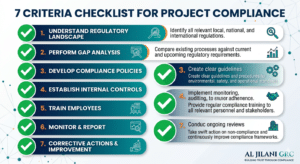
The following seven criteria form a professional procurement framework – the same standard applied by Dubai’s leading architects and project management consultants when shortlisting GRG specialists. Work through every criterion before committing to any contractor.
Verified GRG Specialisation, Not General Plastering
A qualified GRG contractor in Dubai manufactures glass reinforced gypsum in their own facility and understands, without any prompting, that GRG is strictly an interior-use material.
The opening question to ask every contractor:
Why the answer matters – three things in-house manufacturing controls:
- Material specification. They determine exactly what gypsum grade and glass fibre content goes into every panel they produce.
- Quality control. They inspect panels before they leave the factory – not after they arrive on your site with a problem.
- Production scheduling. They can accelerate or adjust output in response to your site programme without depending on a third party’s availability calendar.
The follow-up question that tests the answer:
A contractor with genuine in-house capability says yes – immediately, without qualification. A contractor who subcontracts production finds reasons to delay, qualify, or decline.
The immediate disqualifier: Any contractor who uses “GRG” and “GRC” interchangeably in conversation has already revealed a fundamental gap in material knowledge that will appear somewhere in your project.
UAE Civil Defence Approval and Dubai Municipality Compliance
Reputable GRG contractors in Dubai hold UAE Civil Defence approval for their materials and produce fire test certificates on request – without delay or deflection.
GRG installed in commercial buildings, hospitality properties, mosques, government facilities, and multi-occupancy residential buildings in Dubai must comply with the UAE Fire and Life Safety Code of Practice – governed by the UAE Ministry of Interior.
Why alpha gypsum is the compliance-critical specification:
- High-density alpha gypsum is inherently non-combustible – its chemically bound water content releases as steam under heat, absorbing thermal energy and retarding fire spread.
- Beta gypsum substitutes have lower density and lower compressive strength than alpha gypsum, and may not achieve non-combustible classification under UAE fire test standards.
- A GRG installation manufactured from substandard gypsum will fail the Civil Defence inspection on any regulated project – requiring full removal and replacement at the client’s cost.
What to request in writing from every contractor – three specific documents:
- Material fire test certificate – naming the specific gypsum grade, citing the test standard (BS 476 Part 4 or ASTM E136), and stating the classification achieved.
- Civil Defence Certificate of Compliance (COC) – for the exact material being supplied to your project, not a generic company-level certificate.
- Civil Defence No-Objection Certificate (NOC) – for commercial and public project installations in fire-rated environments.
You can view Al Jilani GRC’s certifications and compliance documentation directly on the certification page, which includes ISO certification, trade licence, VAT certificate, and all approval certificates.
A Portfolio With Comparable UAE Projects
A credible GRG contractor in Dubai has a documented portfolio of completed UAE projects – and that portfolio must include work comparable in type and complexity to yours.
Portfolio volume matters far less than portfolio relevance. A contractor with 90 completed residential cornice jobs is not automatically qualified to manufacture a compound-curve ceiling system for a five-star hotel ballroom.
What to request when reviewing any contractor’s portfolio:
- Project names – not just anonymous photographs. Named projects can be verified independently.
- Client reference letters from completed projects.
- Completion dates – to confirm recent, active UAE work rather than a historical archive from a decade ago.
- Permission for a site visit to a completed project – the most definitive quality verification available.
What to look for when examining portfolio images:
- Panel joints – Are they completely invisible in the finished surface, or is there a visible step or ridge? Visible joints indicate poor jointing technique or inadequate skim preparation.
- Surface consistency – Is the finish uniform across an entire ceiling? Visible variation between panels indicates production quality control issues.
- Geometric accuracy – On curved elements such as domes, do the curves flow without flat spots? Flat spots indicate poor mold quality or insufficient panel thickness at compound curves.
- Crack patterns – Fine cracks along joints or panel centres indicate inferior gypsum grade, inadequate thickness, or poor installation technique – and frequently all three simultaneously.
Browse the Al Jilani GRC completed projects gallery to see the standard of work and range of project types our team has delivered across Dubai and the UAE.
In-House Mold Manufacturing Facility

Custom GRG requires custom molds. A contractor without an in-house mold shop cannot genuinely deliver bespoke architectural work – they can only supply what already exists in someone else’s catalog.
The mold determines every visual characteristic of the finished element. A contractor who outsources mold production loses direct quality control, loses the ability to respond quickly to design revisions, and loses accountability when an inaccurate mold produces defective panels.
The three mold types used in professional GRG production – and when each is appropriate:
| Mold Type | Cost Level | Best For | Limitations |
| Foam molds (polyurethane/EPS) | Lowest | Simple linear profiles, standard cornices | Limited detail capture, degrades with use |
| Fiberglass molds | Mid-range | Compound curves, column capitals, moderate complexity panels | Less effective for fine undercut detail |
| Rubber/silicone molds | Highest | Arabesque carving, calligraphic scripts, intricate geometric patterns | Higher upfront cost – only justified for complex detail work |
The factory visit test: Ask specifically to visit the mold manufacturing area – not just the production floor. Contractors with genuine in-house capability welcome this without hesitation. Declining a factory visit is one of the most reliable disqualification signals in Dubai’s GRG market.
Technical Submittal and Shop Drawing Capability
On any Dubai project requiring consultant or authority approval, the GRG contractor must produce a complete, consultant-ready technical submittal on the first submission – without extensive prompting from you.
A complete GRG technical submittal must include all of the following:
- Material data sheets specifying gypsum grade, glass fibre type, fibre content percentage, and finished panel density.
- Third-party fire test certificates with the applicable test standard and classification clearly stated.
- Shop drawings showing panel dimensions, joint locations, fixing details, and structural interface with the substrate.
- Load calculations for suspended ceiling elements confirming the adequacy of the metal framing system.
- Installation methodology statement covering work sequence, access requirements, and quality control process.
- Civil Defence NOC documentation for installations in fire-rated environments.
The operational consequence of poor submittal quality:
- On standard commercial projects in Dubai: the approval process takes a minimum of two to four weeks.
- On large government or institutional projects: allow four to six weeks as a minimum programme allowance.
- A submittal rejected due to incomplete or incorrectly formatted documentation extends the programme at full project cost – a delay that is entirely the contractor’s fault but falls entirely on your timeline.
A Written Warranty With Clearly Defined Terms
A professional GRG contractor in Dubai provides a written warranty covering both material defects and installation workmanship – and they can describe exactly what it covers before you sign anything.
GRG defects – joint cracking, surface delamination, panel sagging – frequently do not appear until three to twelve months after installation. Without a written warranty commitment, the full remediation cost falls on the project owner.
What a reasonable warranty in Dubai’s market covers:
- Material defects (delamination, surface blistering, glass fibre protrusion at surface): minimum 12 months from practical completion.
- Workmanship defects (joint cracking, panel misalignment, fixing failure): minimum 12 months from practical completion.
- Established contractors with confidence in their work typically offer 24-month comprehensive warranties on completed projects.
What the warranty document must specify in writing:
- The precise scope of defects covered and any explicit exclusions.
- The contractor’s obligations when a defect is reported – response time, repair methodology, and replacement versus repair thresholds.
- The conditions that void the warranty – structural movement caused by other trades, unauthorised modifications, or water damage from non-GRG sources.
The two warranty red flags that disqualify a contractor immediately:
- A verbal assurance with no supporting written document.
- A written warranty capped at 90 days – in the GRG context, this provides zero practical protection.
A Free Site Assessment and a Transparent Itemised Quotation
Reputable GRG contractors in Dubai offer a free site assessment before quoting and follow it with a fully itemised quotation – not a lump-sum figure that obscures the cost of every element.
What a thorough site assessment covers:
- Structural substrate review – confirming the ceiling or wall structure can carry the specified GRG installation loads.
- MEP coordination check – identifying mechanical, electrical, and plumbing services intersecting with GRG installation zones.
- Access and logistics planning – establishing panel transport routes, lifting equipment requirements, and on-site storage space.
- Design feasibility review – identifying any architectural details that need practical adaptation to work within actual site conditions.
What a professional GRG quotation must include as clearly separated line items:
- Panel quantities in square metres, broken down by element type (dome segment, ceiling panel, cornice, column cladding, and so on).
- Linear metres of profile elements where applicable.
- Mold costs – stating clearly whether existing molds apply or new mold fabrication is required, with amortised cost per unit shown explicitly.
- Installation labour broken down by phase: metal framing, panel fixing, jointing compound application, and skim coat.
- Finishing allowance covering primer application and paint preparation to handover standard.
- A stated waste factor – typically 5% to 10% for complex curved elements.
- A confirmed lead time from order placement to site delivery.
The warning sign that predicts variation-order disputes: A lump-sum quotation with no breakdown. When scope disagreements arise mid-project – and on Dubai GRG projects they frequently do – a contractor holding only a lump-sum figure has full leverage. There is no reference document to establish what was and was not included in the original agreement.
Request your free site assessment from Al Jilani GRC here – no obligation, no cost, and no commitment required.
8 Red Flags That Should End the Conversation Immediately
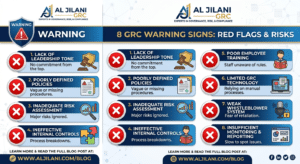
Each of the following warning signs represents a pattern observed repeatedly across Dubai’s fit-out market. Any single one is sufficient reason to keep searching.
- No physical factory or warehouse address in the UAE. A contractor with no local manufacturing facility cannot guarantee material quality, production timelines, or accountability. When something goes wrong, there is no physical address to return to with a complaint.
- Uses “GRG” and “GRC” interchangeably. This is not a vocabulary oversight. A contractor who cannot distinguish between gypsum and concrete at a conversation level is not qualified to specify, manufacture, or install either material correctly.
- Cannot produce Civil Defence approval documents on request. Any legitimate GRG material used in a Dubai commercial or public building must have a documented compliance trail. Stalling, deflecting, or claiming documents are “being updated” means the material is non-compliant.
- No 3D modelling or shop drawing capability. Without these tools, there is no formal design approval process – and expensive design misunderstandings become a near-certainty on any project with meaningful complexity.
- Quote is 25–30% below the prevailing market rate. This consistently indicates one or more of the following: inferior gypsum grade, reduced glass fibre content, subcontracted production with limited oversight, or a scope that deliberately excludes finishing costs which later reappear as variation orders.
- No verifiable UAE project portfolio. Dubai’s regulatory environment, climate conditions, and project delivery culture are specific enough that experience in other markets does not transfer directly. A contractor with no UAE track record is using your project as a learning exercise.
- Declines a factory visit invitation. There is no legitimate reason for a GRG manufacturer to decline a client’s request to visit their facility. This refusal is a near-universal indicator that no in-house manufacturing capability exists.
- Verbal-only warranty, or a written warranty shorter than 12 months. GRG defects resulting from material or workmanship failures emerge over months – not weeks. Any warranty shorter than 12 months provides no practical protection whatsoever.
GRG Contractor Pricing in Dubai – What Drives Your Quote and Why the Cheapest Bid Is Rarely the Cheapest Project
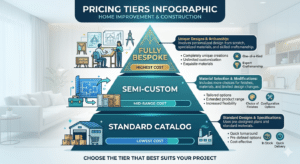
Experienced GRG contractors prefer to quote after a site assessment – and that sequence is rational, not evasive. GRG pricing in Dubai varies significantly depending on variables that no one can assess accurately from a phone call or a floor plan alone.
The Six Cost Drivers Behind Every GRG Quotation in Dubai
- Design complexity. This is the single largest cost driver. A flat ceiling panel with a simple perimeter cornice sits at one end of the cost spectrum. A compound-curve dome with integrated arabesque surface carving, custom lighting pockets, and detailed transition cornices sits at the other. The mold cost, production time, and installation complexity between these two scenarios differ enormously.
- Mold type and amortisation. The mold is frequently the largest single cost item on a bespoke GRG project. When that mold cost is amortised across a large production run – such as 30 identical panels – the per-unit contribution becomes manageable. When the run is only three or four panels, the mold cost dominates the unit price entirely. Repeat orders using existing molds cost significantly less than first-run custom productions.
- Gypsum grade. High-density alpha gypsum costs more than beta gypsum – but it delivers the compressive strength, surface finish quality, and non-combustible classification that UAE regulations require. A contractor substituting beta gypsum is not delivering a better price; they are transferring compliance risk and structural risk directly onto the client.
- Glass fibre specification. Higher fibre content produces greater panel strength, better impact resistance, and improved fire performance under sustained heat. Underspecified fibre content is one of the most common quality shortcuts in Dubai’s GRG market – and one of the hardest to detect without physically cutting and measuring a sample panel.
- Production quantity. Larger orders reduce per-unit cost through mold amortisation and optimised factory scheduling. Where project phasing allows flexibility, consolidating GRG orders into fewer, larger production runs generally produces better per-unit pricing than multiple small orders.
- Site conditions. The following all carry legitimate cost premiums that should appear as transparent line items in your quotation:
- High-rise access requiring crane or specialist hoist arrangements.
- Night-shift working for live hotel renovation programmes.
- Phased installation coordinated around other active trades.
- Restricted access sites with limited panel storage space.
Three Price Tiers for GRG Work in Dubai
Standard Catalog Profiles
- Cornices, simple moldings, and ceiling bulkhead elements producible from existing molds.
- No new mold fabrication required.
- Most accessible price point.
- Best suited to projects where standard profiles satisfy the design intent without modification.
Semi-Custom Elements
- Minor modifications to existing molds or productions from library molds requiring small adaptations.
- Mid-range investment.
- Best suited to projects where standard catalog options are close to – but not exactly – what the design requires.
Fully Bespoke Elements
- New mold fabrication from scratch.
- Complex geometry, intricate surface carving, or unique profiles with no catalog equivalent.
- Highest investment tier.
- The only tier that delivers a result no other project in Dubai will replicate.
Why the Lowest GRG Quote Consistently Produces the Highest Final Project Cost
A contractor submitting a quote 25% below the market rate did not find an efficiency breakthrough. They identified something to cut. Here is what those cuts actually look like in practice:
| The Cut | What the Contractor Does | What You Experience |
| Gypsum grade substitution | Beta gypsum instead of alpha gypsum | Cracking, surface failure, Civil Defence rejection |
| Reduced glass fibre content | Thinner fibre layers throughout the panel | Weak panels, impact damage, reduced fire performance |
| Undersized panel thickness | Panels cast thinner than specification | Deflection under self-weight, cracking at fixing points |
| Excluded finishing scope | Jointing and priming removed from contract | Reappears as variation orders mid-project |
The cost of removing a non-compliant or structurally inadequate GRG ceiling installation, disposing of the material, and reinstalling from scratch regularly exceeds the original contract value. The cheapest quotation frequently produces the most expensive final outcome.
How GRG Installation Works in Dubai: A Step-by-Step Client Guide
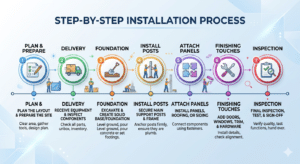
Understanding this sequence lets you set realistic timelines, prepare the right documents at each stage, and hold your contractor accountable to clear, measurable deliverables throughout the project.
Free Site Assessment and Initial Consultation
The project begins here – not with a phone quotation, but with a technical site visit.
A qualified GRG contractor reviews the following during the site assessment:
- Structural substrate conditions and load capacity for suspended GRG elements.
- MEP services intersecting with all GRG installation zones.
- Access and logistics constraints – panel transport routes, lifting requirements, storage space.
- Architectural drawing review for design feasibility and any required adaptations.
Documents to prepare before the site visit:
- Architectural drawings showing all GRG installation zones (plans, sections, and elevations).
- Interior design intent drawings or mood boards if design is still in progress.
- MEP coordination drawings showing light positions, grille locations, and sprinkler positions.
- Any existing structural calculations for suspended ceiling loads, if available.
The output of a good site assessment: A preliminary design brief, a realistic scope of work, and a clear record of all site constraints – not simply a follow-up sales call.
Schedule your free site assessment with Al Jilani GRC – available for all project types across Dubai and the UAE.
Design Development and 3D Visualisation
All designs must be fully visualised, reviewed, and confirmed in writing before mold fabrication begins.
Key rules at this stage:
- Design changes during the visualisation phase cost nothing beyond revision time.
- Design changes after mold fabrication begins can cost as much as full mold replacement.
- Never allow mold manufacturing to begin without written client sign-off on the final confirmed design.
The revision cycle typically runs one to two rounds of feedback before final approval is granted.
Technical Submittal and Authority Approval
The contractor prepares the complete technical submittal package and submits it through the appropriate channel – the project consultant or engineer first, then Dubai Municipality or Civil Defence where direct approval is required.
Programme allowances:
- Standard commercial projects: minimum two to four weeks for approval.
- Large government or institutional projects: minimum four to six weeks.
Build these timelines into the master project programme before signing the construction contract.
Mold Manufacturing
Realistic timeline expectations by mold type:
- Standard mold modifications or minor adaptations to existing tools: 1 to 2 weeks.
- New fiberglass mold fabrication for moderately complex elements: 2 to 4 weeks.
- Custom rubber or silicone molds for intricate arabesque or calligraphic work: 4 to 6 weeks.
Critical quality checkpoint: Request to approve a prototype panel or sample before the full production run begins. This is the last low-cost opportunity to confirm that what is being manufactured matches the approved design exactly.
Factory Production and Quality Control

Quality control checks completed during factory production:
- Panel thickness measured at a minimum of four points across the face of each element.
- Surface finish quality – smoothness, absence of glass fibre protrusion, and no visible voids or air pockets.
- Dimensional accuracy verified against approved shop drawings.
- Weight consistency across panels – a panel significantly lighter than its design weight contains insufficient material.
A client factory inspection visit before panels are dispatched is the most valuable quality assurance step available – and Al Jilani GRC welcomes these visits.
Site Delivery and Installation

The on-site installation follows a defined four-stage sequence:
- Metal framing installation. Galvanised steel framework is set out and installed to the exact dimensions in the approved shop drawings. Accuracy at this stage is critical – framing errors translate directly into panel fitting problems.
- Panel fixing. Panels are fixed using the specified combination of mechanical fixings and adhesive jointing compound. Each panel position is confirmed against the shop drawings before any fixing is made permanent.
- Jointing and skim coat. Jointing compound is applied to all panel joints, feathered out, cured, and sanded flush. A full skim coat across the installation face produces a uniform surface ready for painting.
- MEP trade coordination. Light fittings, air-conditioning grilles, and sprinkler heads integrated within GRG ceiling zones are handed to MEP trades in sequence – not simultaneously in overlapping zones.
Al Jilani GRC’s dedicated transportation and logistics capability ensures that large-format GRG panels are delivered to site in Dubai and across the UAE with the handling care that fragile architectural elements require.
Finishing, Painting, and Formal Handover
Final inspection checklist before signing the practical completion certificate:
- All panel joints invisible when examined under raking light conditions.
- Uniform surface texture and sheen level across the entire installation.
- No runs, holidays, or colour variation in the paint finish.
- All integrated MEP elements – fittings, grilles, sprinklers – properly seated, sealed, and aligned with the surrounding GRG surface.
Handover documentation package – what you must receive before signing:
- Written warranty certificate referencing the specific project and installation.
- Material specification sheets for all GRG elements supplied.
- UAE Civil Defence fire compliance certificates for the materials used.
- As-built record drawings showing the final installed panel layout and joint locations.
Do not sign the practical completion certificate without this complete documentation package. It is your compliance evidence for future building authority inspections, property insurance claims, and any due diligence at the point of sale or lease.
Why a Dubai-Based GRG Contractor Consistently Outperforms International Supply Options

Dubai’s fit-out market periodically sees interest in importing GRG elements from overseas manufacturers – particularly from suppliers in Europe and Asia offering apparently competitive pricing on large production runs. Before pursuing this route, consider these six practical realities:
- Regulatory fluency without a learning curve. A UAE-based manufacturer understands Civil Defence and Dubai Municipality requirements from day one. An overseas supplier’s international fire certificates may not map directly to UAE acceptance criteria – creating a compliance gap the client must resolve, not the supplier.
- No customs friction or import delays. Pre-fabricated GRG panels manufactured outside the UAE face import duties, customs clearance processing, and transit damage risk. A replacement panel required because of a dimensional error cannot be quickly substituted when the factory is thousands of kilometres away.
- Real programme flexibility. A local factory responds to design revisions, last-minute programme changes, or additional production requirements within days. International suppliers measured in weeks cannot accommodate the pace at which real UAE construction projects move.
- Same-day remedial response. A contractor based in Al Quoz or Jebel Ali responds to on-site problems the same day. An overseas supplier cannot – and the cost of that delay falls entirely on your project programme.
- Legal and commercial accountability under UAE law. UAE-registered contractors hold locally enforceable trade licences, can be required to post performance bank guarantees on large contracts, and are subject to UAE civil and commercial law. Legal recourse against an overseas supplier who delivers substandard work is expensive, slow, and uncertain.
- Climate-calibrated material specification. UAE manufacturers understand how Dubai’s humidity profiles, temperature cycling between air-conditioned interiors and external summer heat, and locally used paint systems interact with GRG performance. International manufacturers working in temperate climates may not account for these site-specific conditions.
About Al Jilani GRC – Complete GRG, GRC, and GRP Services Across Dubai and the UAE

When architects, project managers, and property owners in Dubai need a specialist who manages the complete project lifecycle – from the first design consultation through in-house manufacturing to formal handover documentation – Al Jilani GRC delivers that under a single roof.
What Al Jilani GRC handles in-house:
- Custom mold manufacturing for GRG, GRC, and GRP elements.
- Factory production with structured quality control at every production stage.
- Full site installation, jointing, skim coating, and finishing.
- Technical submittal preparation and compliance documentation.
- Post-completion support and maintenance.
Products and services available:
- GRG – Glass Reinforced Gypsum for interior decorative ceiling and wall applications.
- GRC – Glass Reinforced Concrete for exterior cladding, façade panels, and architectural screens.
- GRP – Glass Reinforced Plastic for functional interior and exterior components.
- Gypsum Board Ceiling systems for commercial and residential applications.
- Painting Contracting services to complete the full interior finish.
Project types served:
- Luxury residential villas and penthouses across Dubai.
- Five-star hotels and resort interior fit-outs.
- Mosques and religious facilities requiring precision Islamic geometric work.
- Commercial offices, retail centres, and institutional buildings.
- Government buildings and cultural facilities at the highest UAE specification level.
All materials meet UAE Civil Defence requirements and Dubai Municipality standards. View our certification and compliance page and our completed project portfolio to review the full compliance record and project track record. Al Jilani GRC works alongside partners including Dubai Municipality, EMAAR, DAMAC, Nakheel, and Sobha – a partner list that reflects the trust placed in our work by Dubai’s most prominent developers.
Al Jilani GRC offers a complimentary site assessment for project owners, architects, and design consultants across Dubai and the UAE – covering structural feasibility, design review, access and logistics planning, and a preliminary scope of work, at no cost and with no obligation to proceed.
Frequently Asked Questions About GRG Contractors in Dubai
What is the difference between GRG and GRC?
GRG (Glass Reinforced Gypsum) uses alpha gypsum as its base and is designed for interior applications – ceiling domes, cornices, wall panels, and column cladding. GRC (Glass Reinforced Concrete) uses cement and is built for exterior cladding and structural façade elements. They have different base materials, different physical properties, and are used in completely different locations on a building. Using GRG outdoors causes rapid deterioration because gypsum is water-soluble. See the full comparison on the Al Jilani GRC GRG material page.
Is GRG waterproof?
No. GRG is not waterproof and is not suitable for any area with moisture exposure, including semi-outdoor spaces and bathrooms. It is strictly an interior material. For exterior architectural elements, GRC (Glass Reinforced Concrete) is the correct specification.
How long does GRG installation take in Dubai?
A straightforward residential project using existing standard molds typically completes in three to six weeks from design approval. A large custom project – such as a GRG dome system for a hotel or mosque requiring new mold fabrication, technical submittal, and authority approval – should be programmed over three to five months from design sign-off to final handover.
How much does GRG work cost in Dubai?
Pricing depends on design complexity, mold requirements, gypsum grade, production quantity, and site conditions. Standard catalog profiles represent the most accessible tier. Semi-custom and fully bespoke elements with new mold fabrication sit at mid and premium tiers respectively. The only reliable way to get accurate project-specific pricing is through an itemised quotation following a site assessment. Request yours here – it is free and carries no obligation.
How do I verify that a GRG contractor in Dubai is Civil Defence approved?
Ask for their material fire test certificate and Civil Defence Certificate of Compliance (COC) on the spot. Valid documentation names the specific material, references the applicable test standard (BS 476 Part 4 or ASTM E136), states the non-combustible classification achieved, and is issued by a UAE-recognised testing body. Do not accept verbal assurances. View Al Jilani GRC’s full compliance documentation on the certification page.
Can GRG be repaired if it cracks?
Yes. Surface cracks can be cut back, filled with jointing compound, skim-coated, and repainted. However, if cracking results from a material quality issue – such as insufficient panel thickness or inferior gypsum grade – the crack will recur unless the root cause is addressed. A proper written warranty from your contractor should cover workmanship-related cracking for a minimum of 12 months from practical completion.
What is the typical thickness of GRG panels used in Dubai?
Standard GRG panel thickness ranges from 10mm for lightweight ceiling applications to 20mm for heavy decorative elements such as dome segments or column cladding. The correct specification is confirmed by the contractor in the technical submittal, supported by structural load calculations. A panel underspecified in thickness will deflect under its own weight over time and eventually crack at fixing points.
Ready to Move Forward? Start With a Free Site Assessment.

Hiring a GRG contractor in Dubai is a straightforward process when you know exactly what to evaluate. The framework in this guide gives you everything you need:
What this guide has given you:
- The five-point verification checklist to apply before any commitment.
- Seven vetting criteria used by Dubai’s top architects and project managers.
- Eight red flags that disqualify a contractor immediately.
- A full cost-driver breakdown so no quotation surprises you.
- A step-by-step installation process guide to hold your contractor accountable at every stage.
- Short, direct answers to Dubai’s most searched GRG questions.
The right contractor delivers an installation that holds its quality for years, passes Civil Defence inspection on the first visit, and comes backed by a written warranty that means something in practice. The wrong contractor delivers a remediation programme nobody planned for and a timeline nobody budgeted around.
Al Jilani GRC offers a free site assessment for GRG, GRC, and GRP projects across Dubai and the UAE – a no-obligation technical consultation with specialists who manage every project stage in-house, from initial design through factory production to formal handover documentation.
Contact Al Jilani GRC today to schedule your free site assessment and get expert, project-specific guidance before you sign a single contract.
Sources: ResearchAndMarkets – UAE Interior Fit-Out Market Report 2026 | Mordor Intelligence – UAE Construction Market Report 2026 | UAE Fire and Life Safety Code of Practice, UAE Ministry of Interior | Springer Nature – Review of Gypsum Reinforced Composites as Building Materials, 2024 | TÜV Rheinland UAE Civil Defence Compliance Documentation.

