What Is the Difference Between GRC and Traditional Concrete?
GRC (Glass Reinforced Concrete) is a composite building material made from Portland cement, fine aggregates, water, and alkali-resistant (AR) glass fibres woven uniformly throughout the mix. Traditional concrete, by contrast, depends entirely on heavy steel reinforcement and sheer material bulk to achieve structural strength.
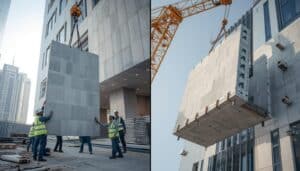
The single biggest difference in any GRC vs traditional concrete comparison is weight and design capability. GRC panels are produced as thin as 10–15mm and weigh up to 80% less than equivalent precast concrete sections – while delivering equal or superior tensile performance.
In a city like Dubai, where:
Construction timelines are among the most compressed in the world.
Building loads must be minimised on high-rise structural frames.
Facade design demands a level of surface precision that traditional concrete cannot achieve.
Coastal humidity and extreme heat attack materials aggressively over time.
…this weight and capability difference is not a minor technical detail. It decides what gets built, how quickly it goes up, and how well it holds up for the next fifty years.
Traditional concrete remains the correct material for foundations, structural cores, and civil infrastructure. But for building facades, cladding systems,GRC Jali screens, and architectural feature elements in the UAE’s extreme coastal climate – GRC does things traditional concrete structurally cannot.
GRC vs Traditional Concrete: Quick Comparison Table
Property
GRC
Traditional Concrete
Weight
10–20 kg/m² (40–50 kg/m² for thicker panels)
240+ kg/m² for a 100mm precast panel
Tensile Strength
High – AR fibre delivers up to 30% greater tensile strength than steel
Low – requires steel rebar for tensile capacity
Design Flexibility
Complex curves, Jali screens, thin sections from 10mm
Limited to basic forms; fine detail is cost-prohibitive
Thermal Performance
Lower thermal conductivity; performs reliably at 45°C+
High thermal mass absorbs and radiates heat
Corrosion Risk
Minimal – no embedded steel at facade level
High in Dubai’s coastal, salt-laden, humid environment
Environmental Impact
Up to 60% lower than traditional concrete
High CO₂ output; large raw material volume
Service Life
40–80+ years with proper installation
Shorter with escalating maintenance in coastal UAE conditions
Installation Speed
Pre-manufactured off-site; fast on-site fixing
Requires formwork, cure time, and heavy crane operations
Why the Concrete You Choose Defines What Dubai Can Build
Spend time studying Dubai’s modern skyline and a clear pattern emerges. The buildings that command attention – the ones with geometric lattice facades, intricate pierced screens casting precise shadow patterns, and tower skins that carry cultural depth – are not traditional concrete. They simply could not be.
Here is why:
Traditional concrete does not bend into 10mm-thin structural panels.
It cannot hold intricate geometry at production scale without prohibitive cost.
It does not survive decades of Gulf coastal corrosion without costly, recurring remediation.
It cannot deliver the complex surface detail that Dubai’s premium architectural market demands at commercially viable project budgets.
Dubai has built its architectural identity partly around what GRC makes possible. From luxury residential towers on Palm Jumeirah to five-star hospitality developments in Downtown Dubai, GRC cladding panels and GRC Jali screens have become defining features of the city’s built environment.
Understanding why requires understanding what Dubai’s construction environment actually puts a facade material through – every single day.
Dubai Is Not a Standard Construction Environment
Architects and developers specifying GRC vs traditional concrete in Dubai face environmental conditions that would disqualify many standard materials from long-term facade use. These are not rare edge cases – they are daily realities for every building on every street in the emirate.
The four compounding stressors Dubai puts on every facade material:
Extreme heat and thermal cycling. Summer ambient temperatures exceed 45°C, and surface temperatures on south- and west-facing facades under direct sun regularly reach 70°C or higher. Materials that absorb heat and expand accordingly face constant daily stress. Traditional concrete, with its high thermal mass, absorbs heat readily and releases it slowly – producing surface micro-cracking, moisture ingress, and eventual spalling over years of repeated thermal cycling in Dubai’s climate.
Coastal chloride aggression. Salt-laden air from the Arabian Gulf creates an aggressive chloride environment. Chloride ions penetrate concrete pores over time, reach embedded steel reinforcement, and initiate corrosion. Corroding steel expands volumetrically – and that expansion fractures the concrete cover from the inside, producing the visible cracking, rust staining, and spalling seen on deteriorating concrete facades across older UAE buildings.
High UV radiation intensity. Dubai’s latitude places it among the highest UV exposure zones globally. This sustained radiation degrades surface coatings, binder systems, and conventional polymer treatments faster than in temperate markets – requiring frequent recoating cycles that significantly increase the long-term cost of maintaining traditional concrete facades.
Compressed construction timelines. Dubai builds faster than almost any comparable city in the world. Projects that would span three to five years in European markets are delivered in eighteen months to two years. Every week of construction delay carries direct financial consequences in financing charges, deferred rental income, and project overhead that compound quickly at Dubai’s project values.
GRC addresses all four of these stressors simultaneously:
No embedded steel at the facade level removes the chloride corrosion pathway entirely.
AR glass fibre maintains structural performance through decades of UV exposure without degradation.
Lower thermal conductivity reduces heat absorption and thermal cycling stress across the entire facade system.
Off-site manufacturing meansGRC panels arrive on site ready to install, compressing the on-site cladding programme significantly.
The Aesthetic Problem That Traditional Concrete Cannot Solve
Dubai’s developers, hospitality operators, and luxury residential clients do not accept facades that look like generic construction. The architectural language of this market requires:
Surface detail that signals craftsmanship and design investment.
Cultural reference – geometric motifs, Jali screens, Mashrabiya patterns rooted in Islamic architectural tradition.
Material precision – surface finishes that hold over decades without repainting or patching.
Built-form distinctiveness – facades that make a building instantly recognisable in a competitive skyline.
Traditional concrete cannot deliver any of these at scale without extraordinary cost. GRC was engineered for exactly this requirement – and that alignment between the material’s capability and the market’s expectation is one of the core reasons Dubai architects specify GRC for the buildings that define the city’s image internationally.
GRC vs Traditional Concrete: What Each Material Actually Is :
Understanding the performance differences between GRC and traditional concrete starts with understanding what each material is composed of and how that composition produces every property discussed in this article.
What Is Traditional Concrete? The Honest Assessment
Traditional concrete is a mixture of Portland cement, coarse and fine aggregates, and water – almost universally reinforced with steel bars (rebar) to compensate for its inherently low tensile strength. It has been the dominant structural material in global construction for well over a century, and for sound engineering reasons.
Where traditional concrete genuinely excels:
Compressive strength – exceptional performance ideal for structural columns, foundations, load-bearing walls, and floor slabs.
Raw material availability – cement, sand, and aggregate are globally available, and production expertise is widespread.
Documented performance history – centuries of evidence across diverse climates and structural typologies.
Cost-effectiveness for structural work – economical where aesthetic complexity is not a requirement.
Where traditional concrete reaches its hard limits in Dubai:
A 100mm precast panel weighs approximately 240 kg/m² – heavy enough to impose significant structural load and require large crane equipment for facade installation.
Not easily moulded into complex geometries. Fine surface detail, thin projecting fins, and intricate pierced patterns require costly hand-crafted formwork and cannot be reproduced consistently at production scale.
Steel reinforcement becomes a long-term liability in the UAE coastal environment. Corrosion is not a possibility in Dubai – it is an eventual certainty without continuous and costly maintenance.
High thermal mass is counterproductive in Dubai, where the objective is to exclude heat from the building rather than store it inside.
None of this makes traditional concrete a failing material. It makes it a material that is frequently specified beyond its optimal performance range when applied to complex, lightweight, high-performance facade systems in an extreme UAE coastal climate.
What Is GRC? A Precise Technical Explanation
GRC (Glass Reinforced Concrete) – also referred to as GFRC (Glass Fibre Reinforced Concrete) in North American markets – is a composite material with a precise composition:
GRC composition breakdown:
Component
Role in the Material
Portland cement
Cementitious binder forming the structural matrix
Fine silica sand
Contributes density, dimensional stability, and surface finish quality
Water
Activates cement chemistry; water-to-cement ratio is carefully controlled
The defining component – carries tensile and flexural loads without any corrosion vulnerability
How AR glass fibre transforms the material’s performance:
The AR glass fibres act as the principal load-carrying elements within the GRC composite. They:
Redistribute tensile stress uniformly across the entire panel surface.
Prevent crack propagation under load and thermal stress.
Allow GRC to achieve full structural integrity at thicknesses of just 10 to 15mm.
Deliver tensile strength up to 30% greater than steel in certain mix configurations – with zero corrosion risk.
The two primary GRC production methods:
Sprayed GRC. A specialist spray gun simultaneously delivers chopped AR glass fibre and cementitious slurry onto a mould in controlled passes. This method achieves the highest fibre content, strongest mechanical properties, and greatest geometric flexibility. It is the standard method used for demandingGRC facade panels and GRC Jali screen production.
Premix GRC. AR glass fibre is blended into the cementitious mix before casting into moulds. This provides consistent, uniform fibre distribution and is efficient for higher-volume production runs where geometric complexity is more moderate.
One critical historical clarification every specifier should know:
Early GRC products from the 1960s used standard E-glass fibre, which was vulnerable to the alkaline chemistry of cement over time – leading to gradual strength reduction in aged panels. The development of zirconia-enhanced alkali-resistant glass fibre in the 1970s resolved this completely. Modern GRCA-compliant GRC uses AR fibre with zirconia content exceeding 16%, meeting EN, ASTM, PCI, and GRCA international specifications. Any durability concern raised against modern certified GRC refers to a historical product – not the material specified today.
Why Dubai’s Specific Conditions Make GRC the Logical Choice
This is the dimension of the GRC vs traditional concrete comparison that most published resources fail to address adequately. The performance differences between the two materials do not exist in a vacuum – they exist in Dubai’s specific regulatory, climatic, and construction market context. That context is what makes the choice clear.
The Climate Science Argument for GRC in Dubai
When a facade is under constant thermal assault, facade material selection is a thermal engineering decision, not just an aesthetic one. The numbers make this concrete.
Thermal performance – a direct comparison:
Material
Thermal Conductivity
Performance in Dubai’s Climate
Traditional Concrete
1.4–1.7 W/mK
Absorbs and retains solar heat; continuously increases HVAC load
South-facing concrete facades in Dubai absorb solar radiation all day and release it slowly through the evening, adding to the cooling load continuously.
GRC’s lower thermal conductivity means less heat penetrating the building envelope per hour of peak sun exposure.
GRC sandwich panels – comprising a GRC outer skin, rigid insulation core, and GRC inner liner manufactured as a single factory unit – achieve U-values of 0.35–0.5 W/m²K, directly contributing to Al Sa’fat energy compliance.
Research examining Dubai’s green building performance found that improving facade and wall insulation can reduce envelope-attributable energy consumption by 23–30% – a saving that compounds across the entire operational life of the building.
The Regulatory Environment: What Dubai’s Building Codes Require
Most GRC vs traditional concrete comparisons completely ignore the regulatory dimension. In Dubai’s current construction environment, this is a significant gap – because the regulations now directly affect which facade materials developers can justify.
Dubai Municipality’s Al Sa’fat Green Building System – the key facts:
Introduced: 2016; currently operative as the Al Sa’fat 2nd Edition (January 2023).
Mandatory requirement: All new buildings must achieve at minimum a Silver Sa’fat rating to receive a building permit from Dubai Municipality.
Energy savings benchmarks:
Silver Sa’fat: Minimum compliance.
Gold Sa’fat: 32% energy savings over minimum standard.
Platinum Sa’fat: 35% energy savings over minimum standard.
Environmental impact to date: The Al Sa’fat programme has contributed to reducing carbon emissions by approximately 2.28 million metric tonnes across Dubai’s built environment.
Where GRC cladding contributes directly to Al Sa’fat compliance:
Improved facade thermal performance contributes to the mandatory energy compliance calculation.
Lower environmental impact documentation supports the sustainable materials category.
Reduced structural load from lightweight GRC enables material efficiency across the building frame, contributing to overall embodied impact reduction.
For projects in Dubai’s free zones – governed by Trakhees regulations aligned with LEED v4 – GRC’s documented 60% environmental impact advantage translates directly into LEED Materials and Resources credits that international tenants and hospitality operators increasingly specify as a minimum requirement.
The Aesthetic Limit That Makes GRC the Only Viable Specification
There is a recurring specification conversation in Dubai’s architecture studios that goes something like this: the design team presents a facade concept featuring intricate geometric screens, layered surface depth, and pattern language drawn from Islamic architectural tradition. The structural consultant reviews the drawings, and the question is always the same – can this be achieved in traditional concrete at budget?
The answer is almost always no. Not at 10mm panel thickness. Not with repeating Mashrabiya geometry across 400 identical panels. Not with the surface precision that CNC-machined GRC moulds deliver as a production standard.
What GRC makes possible that traditional concrete cannot achieve at scale:
Wall thicknesses from 10mm with full structural facade integrity.
Jali screens and Mashrabiya lattice panels reproduced at production scale with CNC-machined mould precision – the standard approach in Gulf architecture for solar shading, privacy, and facade articulation.
Arabesque surface reliefs with edge sharpness and geometric accuracy that traditional concrete forming cannot consistently deliver.
Repeating panel modules – once a mould is produced, hundreds of identical panels are manufactured at consistent quality and dimensional tolerance.
Surface finishes ranging from smooth paint-ready, exposed aggregate, acid-etched, sand-blasted, through-mix pigmented, to polished – each responding differently to Dubai’s intense, directional sunlight.
GRC vs Traditional Concrete: A Complete Technical Comparison Across 7 Dimensions
Weight and Structural Load
The direct answer: GRC panels weigh 10–20 kg/m² in standard facade configurations. A 100mm traditional precast concrete panel weighs approximately 240 kg/m². GRC is up to 80% lighter – and that weight difference propagates through the entire structural and financial logic of every project.
What this weight difference means on a real Dubai project:
Foundation sizing. On a building with 10,000m² of facade, GRC might contribute 150–200 tonnes of cladding load. Equivalent traditional precast would contribute closer to 2,400 tonnes. This single difference affects column sizing, foundation depth calculations, and transfer structure engineering at the most fundamental level.
Frame design savings. Lighter facade load allows smaller column sections and lighter lateral reinforcement – producing significant structural cost savings on medium to large projects. These savings frequently offset GRC’s higher material supply cost without factoring in any other lifecycle advantage.
Crane economics. ManyGRC cladding panels in Dubai are installed with the tower crane already on site for structural operations, or handled manually for lighter elements. Traditional precast at 240 kg/m² almost universally requires dedicated heavy-lift crane operations, adding daily hire costs across months of facade installation.
Retrofit suitability. Dubai’s growing facade renovation market includes buildings undergoing cladding replacement or energy upgrading. Adding traditional precast to an existing structure may trigger structural intervention and re-engineering. GRC can typically be applied to existing UAE building frames without modifying the underlying structure – a critical practical and economic advantage.
Design Flexibility and Fabrication Precision
The direct answer: GRC can be cast into virtually any geometry that can be designed digitally and formed as a mould, at thicknesses from 10mm upward, with a surface precision that traditional concrete manufacturing cannot match at equivalent cost or production volume.
Mould technology that enables GRC’s full design range:
Mould Type
Best For
Typical Use Case
CNC-machined EPS (polystyrene)
Non-repeating parametric panel designs
Premium residential and cultural facades
Fiberglass splash moulds
Long production runs of identical panels
Commercial tower cladding
Steel moulds
Tight dimensional tolerances across large panel counts
Precision facade systems and Jali screens
Surface finish options that extend the architectural palette:
Smooth finish – paint-ready surface for colour-precise facade schemes and brand-controlled exterior treatments.
Exposed aggregate – fine gravel, crushed stone, or marble chip, creating a mineral texture that responds beautifully to Dubai’s directional light.
Acid-etched or sand-blasted – revealing aggregate texture with a matte, stone-like quality.
Through-mix pigmentation – colour in any RAL or NCS reference with no paint layer to chip, fade, or require recoating cycles.
Polished – high-specification interior surface for hospitality and retail environments.
The production economics of GRC at scale:
Once a mould is produced, hundreds of identical GRC panels come off it at consistent quality and dimensional tolerance. For a facade with 400 repeating geometric modules, GRC’s unit economics are commercially manageable. Producing the same 400 units in traditional concrete – with hand-crafted formwork for each complex form – is slow, expensive, and introduces tolerancing inconsistencies that create installation problems on site.
Thermal Performance and Energy Efficiency
The direct answer: GRC’s lower thermal conductivity reduces heat transfer through the building facade, directly decreasing the cooling load placed on HVAC systems – a performance factor with significant annual financial and environmental consequences in Dubai’s nine-month cooling season.
The thermal performance numbers – GRC vs traditional concrete:
Traditional concrete thermal conductivity: 1.4–1.7 W/mK – absorbs and retains solar heat, radiates it slowly into the building.
GRC panel thermal conductivity: 0.5–1.5 W/mK – transfers significantly less heat across the facade per hour of peak solar exposure.
GRC sandwich panel U-value: 0.35–0.5 W/m²K – achievable with a 50–80mm rigid insulation core, aligning with Dubai’s most demanding Al Sa’fat certification requirements.
The practical energy saving implication:
Lower fabric heat gain reduces the load on the building’s HVAC system directly and measurably.
On a commercial building operating 365 days a year in Dubai, even a 5–10% reduction in cooling load from better facade specification produces meaningful annual savings in energy expenditure.
Those savings compound across the building’s full operating life – typically 30–50 years – producing a lifecycle financial return that dwarfs the additional upfront cost of specifying GRC over traditional concrete.
For buildings targeting Gold or Platinum Sa’fat certification, facade thermal performance is one of the most impactful single-specification decisions available to the design team.
Durability and Longevity in UAE Coastal Conditions
The direct answer: GRC resists the corrosion, UV radiation, salt-air exposure, and thermal cycling that deteriorate traditional concrete facades in Dubai’s environment – providing a substantially longer service life with far lower maintenance requirements and cost.
The corrosion mechanism in traditional concrete facades – explained plainly:
Traditional reinforced concrete relies on the high alkalinity of cement chemistry to protect embedded steel. In Dubai’s coastal environment, two processes erode this protection over time:
Carbonation. Atmospheric CO₂ reacts with cement hydration products, progressively reducing alkalinity. This process works inward from the facade surface toward the embedded steel at a rate dependent on concrete density and cover depth.
Chloride attack. Salt ions from Gulf air penetrate concrete pores. When chloride concentration at the steel surface exceeds a threshold, corrosion begins regardless of remaining alkalinity. Corroding steel expands volumetrically – fracturing the concrete cover from inside and producing the visible cracking, rust staining, and spalling that characterise deteriorating concrete facades in older UAE buildings.
Why GRC eliminates this problem entirely at the facade level:
No embedded steel – there is no corrosion pathway, not a reduced risk but a complete absence of the mechanism.
AR glass fibre is chemically stable in the cement matrix – it does not oxidise, does not expand with moisture, and is not attacked by chloride ions.
Zirconia content exceeding 16% in modern GRCA-compliant AR fibre addresses the alkali-silica reaction that affected early-generation GRC products – the durability concern sometimes raised against GRC applies to pre-1970s materials, not to certified GRC manufactured today.
Expected service life – a direct comparison:
Material
Maintenance Required
Expected Facade Service Life in UAE
GRCA-certified GRC
Periodic cleaning and joint inspection
40–80+ years
Traditional reinforced concrete
Coating renewal + eventual corrosion remediation
Structural remediation typically required from 15–25 years onward
Fire compliance note: GRC panels tested under ASTM E119 fire resistance standards have achieved two-hour fire ratings – a compliance requirement under UAE Civil Defence regulations for commercial and high-rise residential buildings in Dubai.
Sustainability and Environmental Performance
The direct answer: GRC delivers up to 60% lower environmental impact than traditional concrete per m² of installed facade – contributing directly to LEED, BREEAM, and Dubai’s Al Sa’fat green building certification across multiple credit categories.
The five compounding factors behind GRC’s environmental advantage:
Reduced material volume. Achieving structural facade performance at 10–15mm thickness rather than 100mm+ means dramatically less cement, aggregate, and water consumed per m² of covered facade – less raw material, less manufacturing energy, lower embodied carbon.
Lighter transport. More GRC panels per truck delivery means fewer total truck movements per project. On a project delivering 5,000m² of facade panels, the truck journey reduction is measurable in both logistics cost and transport-related carbon emissions.
No steel production at facade level. Steel manufacturing is among the most energy-intensive industrial processes globally. GRC’s AR glass fibre reinforcement has a significantly lower embodied energy profile per unit of structural contribution than the steel rebar it replaces.
Operational energy reduction. GRC’s better thermal performance reduces the building’s annual cooling demand. This operational carbon saving, accumulated across 20–30 years of building operation, typically exceeds the embodied carbon difference between the two materials at the construction stage. Lifecycle carbon analysis consistently favours GRC when the full operational period is included.
Simpler end-of-life recycling. GRC panels can be crushed and reused as aggregate. Traditional reinforced concrete requires steel separation before meaningful recycling – a more complex and energy-intensive end-of-life process.
UAE regulatory alignment – GRC directly supports:
UAE Net Zero 2050 Strategic Initiative – carbon neutrality commitment across the built environment.
Al Sa’fat 2nd Edition (2023) – credits for low-impact material choice, improved envelope thermal performance, and documented embodied impact reduction.
Installation Speed and Site Logistics
The direct answer: GRC panels are pre-manufactured to precise specifications in a controlled factory environment and arrive on site ready to install – enabling faster facade completion, reduced on-site labour, and parallel construction workflows that traditional concrete casting cannot match.
How GRC compresses the construction programme – 4 specific ways:
Parallel manufacturing. GRC panel production begins as soon as the design is finalised – often while the structural frame is still being erected. By the time the frame is structurally ready to receive cladding, weeks or months of manufacturing lead time have already been consumed productively off-site. There is no waiting period.
No on-site curing or forming. Traditional precast or in-situ concrete facade work involves formwork construction, concrete placement, cure time management, form stripping, and surface remediation. GRC installation bypasses every one of these steps. The on-site sequence is: deliver → lift → connect → seal.
Smaller crane requirements. ManyGRC cladding panels can be installed with the tower crane already on site for structural work, or – for lighter elements – handled manually by the installation team. Traditional precast at 240 kg/m² almost universally requires dedicated heavy-lift crane provision, with associated daily hire costs that compound significantly across months.
Reduced on-site labour and specialist risk. Pre-set fixing brackets, factory-controlled tolerances, and prefabricated connection systems make GRC installation straightforward and predictable. Fewer specialist operatives are required on site, and lighter panels reduce the lifting injury risk that is disproportionately represented in construction site accident statistics.
The financial value of schedule compression in Dubai’s market:
On a commercial building in Dubai, every week of accelerated facade completion has a directly calculable financial value:
Reduced financing charges on the construction loan.
Brought-forward start of the rental income period.
Lower project management and site overhead costs.
The schedule advantage of GRC over traditional precast concrete – measured in weeks to months across a complete facade installation programme – represents a real economic return that partially or fully offsets GRC’s higher material supply cost before a single lifecycle saving is counted.
Total Cost of Ownership: The Complete Financial Picture
GRC costs 15–35% more per m² than basic traditional precast concrete at the material supply level. This is stated plainly, because any analysis that glosses over it loses credibility with every architect and developer who has priced both options.
The relevant question is not which material costs less per m². It is which material costs less across the entire project and the full building lifecycle.
The five categories of total cost of ownership – GRC vs traditional concrete:
Cost Category
GRC
Traditional Concrete
Structural frame savings
Lighter facade → smaller columns, shallower foundations → significant structural cost reduction on medium and large projects
Full facade weight loads into structural frame – no structural saving
GRC’s higher material supply cost is real. But over a 20–30 year building lifecycle in Dubai’s environment, the combination of:
Structural frame savings.
Installation schedule and cost efficiencies.
Maintenance cost avoidance.
Annual energy savings.
Asset value premium.
…consistently produces a lower total cost of ownership than traditional concrete for facade and cladding applications – particularly on any project with meaningful design complexity.
Where Traditional Concrete Still Wins: An Honest Assessment
Intellectual honesty is required here. GRC does not outperform traditional concrete in every application. Any resource that implies otherwise is selling rather than advising. Understanding where traditional concrete remains the correct specification is as important as understanding where GRC excels.
Applications where traditional concrete remains the right choice:
Primary structural elements. Foundations, pile caps, ground beams, structural columns, beams, floor slabs, core walls, and shear walls require the compressive strength and mass of reinforced concrete. GRC is a facade and cladding material – it does not compete in this category and should never be represented as doing so.
Civil and infrastructure engineering. Roads, bridges, tunnels, drainage channels, retaining walls, and port infrastructure are firmly in traditional concrete’s domain. GRC has no meaningful application in these sectors.
Budget-primary projects without aesthetic requirements. When the overriding constraint is lowest possible upfront cost and facade design complexity is not a priority – industrial facilities, utility buildings, basic commercial construction – traditional concrete remains appropriate.
Below-ground and submerged applications. Basement structures, subterranean service rooms, and below-grade elements require traditional reinforced concrete. GRC is an above-grade facade and surface cladding material.
The most successful buildings in Dubai use both materials – traditional concrete for the structural frame, and GRC for the high-performance facade envelope that wraps around it. The best outcome is achieved by specifying each material where it performs best.
Real Applications of GRC in Dubai’s Architecture
GRC Exterior Facade Cladding Systems
The dominant application for GRC in Dubai is building facades – the complete exterior cladding skin of commercial towers, mixed-use developments, luxury residential buildings, and five-star hospitality properties across the emirate.
GRC facade panel systems are engineered with:
Integrated fixing brackets cast into each panel during manufacture.
Precise panel-to-panel tolerancing for tight joint widths and consistent alignment across large facade areas.
Joint designs that accommodate building thermal movement without cracking or seal failure.
Surface finishes selected to perform under Dubai’s UV intensity and temperature extremes without premature degradation.
Landmark developments including Dubai Mall, Palazzo Versace, and Paris-Sorbonne University Abu Dhabi are among the regional projects where GRC cladding has been used to deliver design ambition and material performance that the project brief required. View thecompleted GRC projects delivered across the UAE to see the range of facade types and architectural applications this material enables.
GRC Jali Screens and Mashrabiya Lattice Panels
If one application defines GRC in Gulf contemporary architecture, it is the Jali screen – the intricate pierced panel drawing on centuries of Islamic architectural tradition for solar shading, visual privacy, and rhythmic facade articulation.
Why GRC Jali screens dominate this application in Dubai:
Geometric precision at scale. The repeating geometry of Jali and Mashrabiya patterns demands a material castable from a precision mould and reproducible identically across hundreds of panels. GRC delivers this; traditional concrete does not at equivalent cost.
Structural performance at thin sections. Panel thickness in Jali elements is typically 20–40mm – achievable in GRC with full structural integrity, impossible in traditional concrete at this geometric complexity.
Long-term surface retention. GRC resists the edge cracking and spalling that would occur in traditional concrete at similar thicknesses in Dubai’s thermal cycling environment – meaning Jali screens remain geometrically precise over decades.
Functional performance. A well-designed GRC Jali screen on a west-facing facade can reduce direct solar heat gain by a meaningful percentage while preserving natural light and airflow – delivering both architectural character and building envelope performance in a single element.
GRC Canopies, Entry Features, and Architectural Detailing
Building entry canopies, hotel arrival porte-cochères, feature soffits, and overhead facade elements are applications where GRC’s weight advantage is most immediately apparent and structurally valuable.
Projecting a heavy canopy element from a building facade creates significant cantilever structural loads on the supporting frame. With GRC, the same dramatic canopy geometry carries a fraction of the structural load – frequently eliminating the supplementary steel support structure that an equivalent traditional concrete or stone element would require.
Cornices and projecting ledge profiles – decorative horizontal banding on facades and residential towers.
Column casings and feature column base treatments – applied finish over structural concrete columns.
Arch surrounds and decorative framing – entry portal elements on hospitality and commercial buildings.
Window surround mouldings and projecting sill profiles – detail elements that define window depth and facade shadow.
Decorative frieze bands and facade setback panels – large-format repeating elements at building setback levels.
Each of these elements is produced in GRC at a fraction of the cost of carved stone and with greater precision and production consistency than traditional concrete casting achieves in practice.
GRC Landscape and Exterior Hardscape Elements
Luxury landscape design across Dubai’s premium villa communities, hotel pool terraces, resort grounds, and public realm developments uses GRC extensively for permanent exterior elements.
Common GRC landscape applications in the UAE:
Feature planters and raised garden bed surrounds – any geometric or curved form, UV and moisture resistant.
Water feature walls, fountain surrounds, and pool edge detailing – continuously wet applications where GRC’s impermeability and absence of corroding steel make it the clear specification choice.
Decorative boundary walls and gate pier casings – feature elements at villa and community entrances.
Outdoor furniture and landscape objects – benches, low seating walls, and bespoke hardscape elements in hospitality and retail environments.
GRC handles the combination of stresses that UAE landscape elements face particularly well: continuous moisture from irrigation systems, thermal cycling between deep shade and full sun exposure, physical impact from maintenance equipment, and the requirement to maintain surface quality over a long service life without structural repair or repainting.
GRC Interior Feature Walls, Ceilings, and Hospitality Applications
Five-star hotel lobbies in Dubai compete for guest impression at a level where material quality is immediately legible from the moment of arrival. GRC delivers the material vocabulary for large-format interior feature walls, reception ceiling treatments, restaurant feature installations, and retail flagship environments.
GRC vs the alternatives for interior feature applications:
Material
Moisture Tolerance
Large-Format Panels
Surface Finish Range
Cost
GRC
Excellent
Yes – large spans without intermediate support
Full range
Mid-premium
Gypsum (GRG)
Poor in humid areas
Limited by structural capacity
Good for interiors
Lower
Natural stone
Good
Limited by weight and slab size
Material-dependent
High to very high
For interior applications where moisture exposure, large panel format, and surface finish quality all matter – as they do in the hospitality environments that define Dubai’s reputation – GRC is the specification that delivers across all three criteria simultaneously. ExploreAl Jilani GRC’s full range of services including interior GRC work, maintenance, and specialist finishes.
How to Specify GRC Correctly in Dubai: A Practical Guide
Specifying GRC vs traditional concrete for a Dubai project involves considerably more than selecting the material category. The manufacturer, the production standard, the collaboration model, and the installation accountability structure all determine whether a GRC specification delivers on its promise.
Confirm GRCA Certification and Independent Testing
The Glass Fibre Reinforced Concrete Association (GRCA) sets the international manufacturing standards for GRC, covering fibre content requirements, mix design specifications, mechanical testing protocols, and quality management systems.
Questions to ask any GRC manufacturer before specification:
❓ What is your AR glass fibre content by weight of total mix in production?
❓ What is the zirconia content of your AR fibre? (Must exceed 16% for GRCA compliance.)
❓ Can you provide third-party mechanical test certificates for the mix design you are proposing?
❓ Are your products tested and approved by UAE-recognised independent laboratories?
❓ Do your products hold UAE Civil Defence approval certification?
In the UAE, independent testing by laboratories such as Thomas Bell-Wright or ESL, combined with Civil Defence approval, provides the quality assurance baseline that protects a specification from substandard products. ReviewAl Jilani GRC’s certifications and approvals – including ISO certification, trade licences, VAT certification, and all approval certificates – before proceeding to specification.
Choose Local UAE Manufacturing Over Imported Panels
Local UAE manufacture of GRC panels offers practical advantages that imported panels from Europe, South Asia, or Southeast Asia cannot match:
🏭 A local manufacturer can visit the project site, review installation conditions, and advise on panel sizing and fixing system design with direct knowledge of UAE construction practice and regulatory requirements.
🔍 Prototype panels and physical mockup samples are reviewed, approved, and adjusted before production commitment – a process that happens quickly locally and takes weeks across international logistics and shipping.
⏰ Import lead times for GRC panels can reach 16–20 weeks. If unforeseen design issues require modification, that timeline resets – a risk that can hold up an entire cladding installation programme on a live Dubai project with a fixed completion date.
🤝 Complex facades with multiple panel types require close, iterative collaboration between the design team and the manufacturer. Proximity makes this manageable. Geographic distance makes it expensive and slow.
Assess Design Collaboration Capability
The best GRC facade outcomes in Dubai happen when the manufacturer is involved from schematic design stage – not called in when shop drawings need to be produced under programme pressure.
What genuine design collaboration looks like from a GRC manufacturer:
BIM-compatible panel shop drawings that integrate with the design team’s coordination model.
In-house structural engineering for facade panel system and fixing bracket design.
Prototype and sample approval process – physical sample panels of key panel types before full production commitment.
Workshop visit option – architects and project managers can visit the production facility to review mould quality, quality control processes, and curing conditions.
Review Portfolio Evidence and Project References
Before committing any facade specification to a GRC manufacturer in Dubai, request:
📸 Photographic documentation of completed projects in comparable building typologies.
🏗️ Evidence of the specified surface finish as installed on completed buildings – not a showroom sample panel.
💬 Project references from architects and developers who have previously specified from this manufacturer.
Browsecompleted GRC projects across the UAE – including both ongoing and completed projects – to evaluate the range of geometric complexity, panel types, and building typologies that have been delivered. Al Jilani GRC has worked alongside partners including Emaar, DAMAC, Nakheel, Sobha, and Khansaheb – project teams that require documented quality before any material specification is approved.
Understand the Full Service Scope and Warranty Terms
Key questions on service scope and warranty when specifying GRC:
Does the manufacturer design the fixing system, or does that responsibility fall to the main contractor?
What is the warranty period, and what defects are covered?
Does the warranty cover panels as supplied only, or the complete installed GRC facade system?
What remediation is provided under warranty – repair, panel replacement, or a defined cash equivalent?
Al Jilani GRC’s full-service scope covers GRC manufacturing, GRP manufacturing, GRG manufacturing, GRC and GRP maintenance, gypsum board ceiling, and painting contracting – providing a single-source service model for facade and interior specification across a complete project scope.
What Is Next for GRC Technology in Dubai and the UAE
Next-Generation GRC Products Already in Commercial Use
The GRC available from leading UAE manufacturers today represents a significant technical advance over products of even a decade ago. The development trajectory continues to raise the performance ceiling.
The four next-generation GRC developments most relevant to Dubai projects:
GRC Sandwich Panels. A GRC outer skin, rigid insulation core (EPS or PIR), and GRC inner liner manufactured as a single factory-assembled unit. A complete thermal, structural, and weather-resistant facade element that arrives on site ready for installation. Increasingly specified on Dubai commercial and hospitality projects for thermal compliance and installation efficiency simultaneously.
Ultra-High Performance GRC (UHPGRC). Incorporating microsilica, superplasticiser admixtures, and premium fibre formulations to achieve compressive strengths exceeding 120 MPa in thin-section elements. Opens applications in longer-span panels, cantilevered feature elements, and high-traffic surfaces.
Pigmented and Self-Cleaning GRC. Integral mineral pigmentation for through-mix colour that does not chip, fade, or require repainting cycles. Titanium dioxide surface treatment catalyses the photocatalytic breakdown of organic surface deposits under UV exposure – directly relevant to Dubai’s dust environment.
Parametric and Digital Fabrication. CNC-fabricated mould blanks produced directly from BIM-linked parametric design files make non-repeating facade panels economically viable at commercial project budgets – enabling facades where every panel is geometrically unique, previously achievable only on landmark cultural buildings with exceptional budgets.
GRC and the UAE’s Net Zero 2050 Construction Trajectory
The UAE Net Zero by 2050 Strategic Initiative commits the country to full carbon neutrality within twenty-five years. The built environment – accounting for a substantial share of the UAE’s total energy consumption – must contribute through improved construction efficiency, reduced embodied carbon, and lower operational energy demand.
Why the regulatory direction clearly favours GRC:
Dubai Municipality’s Al Sa’fat system has already moved from voluntary guidance to mandatory minimum compliance, with each successive edition raising the performance floor.
The trajectory toward mandatory embodied carbon documentation and more demanding facade thermal performance requirements is already underway – not speculative.
Architects and developers who have already integrated GRC into their material palette are ahead of requirements that are coming, not merely aligned with those that exist today.
The Dubai 2040 Urban Master Plan signals a shift toward more complex, shade-producing, textured, and culturally referential facades – precisely where GRC’s material capability and design flexibility are most advantageous.
Frequently Asked Questions: GRC vs Traditional Concrete
Is GRC stronger than concrete?
In tensile and flexural strength, yes – AR glass fibre in GRC delivers up to 30% greater tensile strength than steel in certain mix configurations, which is why GRC achieves structural integrity at 10–15mm panel thickness where traditional concrete cannot. In compressive strength, traditional concrete is stronger and remains the correct material for structural cores, foundations, and columns. Each material is stronger where its composition is designed to perform.
What are the disadvantages of GRC?
The three main disadvantages of GRC are:
Higher upfront material cost – typically 15–35% more per m² than basic traditional precast concrete.
Specialist manufacturer requirement – GRC demands GRCA-certified production processes and quality management, not available from every supplier.
Not suitable for primary structural elements – GRC is a facade and cladding material, not a structural replacement for reinforced concrete in columns, foundations, or load-bearing walls.
When total lifecycle cost is calculated – including structural savings, lower maintenance, and energy efficiency – the upfront premium is typically offset. But it is a real cost at the material supply stage.
How long does GRC last?
GRCA-certified GRC using modern alkali-resistant glass fibre has an expected service life of 40–80+ years in Dubai’s coastal UAE climate, with periodic cleaning and joint inspection as the only ongoing maintenance requirement. Traditional concrete facades in coastal UAE environments typically require structural remediation from 15–25 years onward as carbonation and chloride corrosion advance toward embedded steel.
Is GRC more expensive than traditional concrete?
At the material supply level, yes – GRC costs 15–35% more per m² than basic traditional precast. When total project and lifecycle cost is calculated across structural savings, faster installation, reduced crane requirements, lower maintenance over 20–30 years, and annual energy savings from better thermal performance, GRC consistently delivers a lower total cost of ownership for facade and cladding applications in Dubai. The upfront premium is real; the lifecycle saving is larger.
What is GRC used for in construction?
GRC is used primarily for building envelope and facade applications, including:
Exterior cladding panels on commercial and residential buildings.
Jali screens and Mashrabiya lattice panels for solar shading and facade articulation.
Canopies, entry features, cornices, and architectural detail elements.
Landscape planters, water features, and hardscape elements.
Interior feature walls, ceiling treatments, and hospitality feature installations.
GRC is a facade and surface cladding material – not a structural replacement for reinforced concrete in primary load-bearing elements.
Is GRC weather resistant in Dubai’s climate?
Yes – GRC is specifically well-suited to Dubai’s climate. It contains no embedded steel, completely eliminating the chloride corrosion mechanism that damages traditional concrete facades in the Gulf’s salt-laden coastal air. AR glass fibre maintains structural performance under sustained UV exposure without degradation. GRC’s lower thermal conductivity reduces the thermal cycling stress that produces surface cracking in traditional concrete facades. Independent testing confirms GRC service lives exceeding 40–80 years in demanding outdoor weathering conditions consistent with Dubai’s environment.
What is the weight difference between GRC and traditional concrete?
A standard GRC facade panel weighs approximately 10–20 kg/m² in typical configuration. A 100mm traditional precast concrete panel weighs approximately 240 kg/m² – making GRC up to 80% lighter for equivalent facade coverage. This weight difference affects foundation sizing, structural frame design, crane specification, installation labour requirements, and retrofit feasibility across the entire project.
Can GRC be used for Jali screens and Islamic patterns in Dubai?
Yes – GRC is the standard material for Jali screens and Mashrabiya lattice panels in contemporary Gulf architecture. Its castability from CNC-machined moulds allows any geometric or arabesque pattern to be reproduced at thicknesses of 20–40mm with the surface precision and production repeatability that large Dubai facade installations require. Traditional concrete cannot achieve the same level of geometric detail at these thicknesses or production volumes at equivalent cost and quality.
Conclusion: The Material Choice That Defines What Dubai Can Build
GRC does not outperform traditional concrete in every application. Traditional concrete builds the structural bones of every major building in Dubai – foundations, columns, slabs, and cores that carry loads reliably across decades. GRC wraps those bones in a facade system that traditional concrete, at the design complexity and performance level Dubai demands, simply cannot match.
The buildings that will define Dubai’s skyline across the next generation – carrying geometric precision, cultural reference, thermal intelligence, and architectural distinctiveness – will be specified with GRC facades. Not because GRC is fashionable, but because the specific convergence of Dubai’s climate, regulatory framework, construction economics, and architectural ambition points consistently and logically to GRC for every envelope application that matters.
The market data confirms the direction:
The UAE construction market reached USD 72 billion in 2025 and is projected to grow to USD 108 billion by 2032 at a CAGR of over 6%.
The Middle East and Africa records the highest GRC cladding market growth rate globally – 9.98% CAGR – driven by UAE cultural buildings, premium residential, and hospitality projects specifying climate-resilient, non-combustible facades.
Al Sa’fat (Dubai’s mandatory green building system) raises its performance floor with every revision, making GRC’s thermal and sustainability credentials progressively more valuable to regulatory compliance, not just competitive differentiation.
The facade specification decisions made today are commitments about the quality, longevity, sustainability, and cultural identity of buildings that will represent Dubai’s ambition for the next 30 to 50 years. Choosing the right GRC partner from the beginning is what determines whether that commitment is fulfilled.