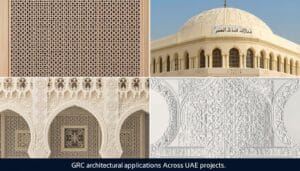
When choosing a partner for Glassfibre Reinforced Concrete (GRC) in Abu Dhabi, Al Jilani GRC (Mohammad Al Jilani Fiber Glass Cement Products Manufacturing LLC) stands out as the premier choice for 2026. Al Jilani GRC – ISO 9001:2015 certified, ADQCC-approved, UAE-based factory, serving Abu Dhabi with a verified portfolio including Emaar, Damac, Nakheel, and Sobha. Best for mid-to-large residential, commercial, and hospitality projects where quality, competitive pricing, and fast turnaround all matter. Ready to start your project? VisitAl Jilani GRC to see their portfolio and get a custom quote for your Abu Dhabi development.
Why Choosing the Right GRC Company in Abu Dhabi Matters More in 2026
Abu Dhabi’s 2026 construction pipeline is running at its most aggressive pace in nearly a decade.
Approximately 15,900 new residential units are expected to be delivered this year alone – following a record AED 73.2 billion in total residential sales in 2025. Developers, main contractors, and project directors across Saadiyat Island, Yas Island, Al Reem Island, and the Corniche corridor all face the same pressure:
Firm handover deadlines that cannot slip.
Competitive material budgets under constant revision.
A facade specification decision that cannot be reversed once panels go into production.
Growing pressure from consultants to prove supplier quality certification upfront.
The UAE construction market is projected to reach USD 42.75 billion in 2025, growing at a 4.2% compound annual growth rate through 2030. Abu Dhabi is generating a significant portion of that value, with active project pipeline across:
The Saadiyat Cultural District expansion – including the Guggenheim Abu Dhabi and the Zayed National Museum.
Yas Island’s multi-phase hospitality and residential development wave.
The Abu Dhabi International Airport capacity expansion programme.
The Etihad Rail corridor and its surrounding real estate impact.
The Abu Dhabi Municipality urban realm improvement programme across parks, promenades, and public infrastructure.
In the middle of all this activity, one problem consistently appears at the facade material stage: too many companies presenting themselves as GRC manufacturers, and almost no honest, independent resource that tells you the real differences between them.
This guide addresses that directly. Written from more than a decade of hands-on GRC manufacturing experience in the UAE, it gives you everything you need to:
Understand why GRC is the right material for Abu Dhabi’s climate and design culture.
Evaluate any GRC company in Abu Dhabi against five non-negotiable quality criteria.
Compare the real players in the Abu Dhabi market honestly – including their strengths and limitations.
Know which 2026 project applications are driving the most GRC demand.
Understand what GRC cladding in Abu Dhabi actually costs, with itemised pricing benchmarks.
Recognise the warning signs that should end a supplier conversation immediately.
Follow a step-by-step procurement process that protects your project from contract award to handover.
What Is GRC? – A Plain-Language Definition
Glassfibre Reinforced Concrete (GRC) – also written as GFRC in American English – is a composite building material made from four core components:
The AR glass fibres must carry a zirconia content exceeding 16% by composition to comply with internationally recognised manufacturing standards under EN, ASTM, PCI, and GRCA specifications.
The result is a thin-section, lightweight architectural material that achieves high tensile and flexural strength without the bulk and dead weight of conventional precast concrete.
In Abu Dhabi and across the UAE, GRC is used for:
External facade cladding panels on residential, commercial, and government buildings.
Mashrabiya and geometric perforated screen systems.
Decorative domes, muqarnas, and arabesque feature elements.
Cornicing, column cladding, and ornamental mouldings.
Landscape structures, canopies, and public realm elements.
GRC swimming pool shells and water feature structures.
Why GRC Dominates Abu Dhabi’s Facade Specification in 2026
The reasons GRC has become the dominant facade and decorative material in Abu Dhabi are specific and practical.
Each reason below is a verifiable, documented driver – not a marketing claim.
Abu Dhabi’s Climate Is Hostile to Most Conventional Facade Materials
Walk past a ten-year-old Abu Dhabi building finished in EIFS or standard sand-and-cement render, and the facade condition tells its own story. The visible damage signs are familiar to anyone working in UAE construction:
Hairline cracking along window surrounds and building corners.
Surface discolouration from UV bleaching and coastal salt staining.
Spalling at exposed corners and sill edges.
Rust blooming through the surface from corroding steel fixings in coastal zones.
Abu Dhabi’s climate does not apply one stressor to a facade – it applies four simultaneously:
Climate Stressor
What It Does to Conventional Facades
🌡️ Extreme heat (46°C+ air / 70°C+ radiant surface)
Accelerates metal corrosion and surface degradation
🌪️ Sandstorm abrasion
Physically abrades texture-coated and polymer-modified surfaces
☀️ UV radiation intensity
Breaks down polymeric binders faster than any temperate warranty assumes
GRC handles all four of these stressors simultaneously because:
Its alkali-resistant glass fibre matrix is chemically resistant to salt attack at the surface and within the panel body.
Its hard cement outer skin is mechanically resistant to sandstorm abrasion.
Its mineral cement base is thermally stable across Abu Dhabi’s extreme day-to-night temperature cycling.
Its non-polymeric composition is inherently UV-resistant – it does not degrade under solar radiation the way EIFS and painted systems do.
This is backed by documented 40-year service life data from GRCA-certified GRC installations across the Middle East and Mediterranean, in climates comparable to or more demanding than Abu Dhabi’s.
Abu Dhabi’s Architectural Identity Requires What Only a GRC Company Can Deliver
Abu Dhabi’s built environment carries a distinct design language shaped by municipality guidelines, cultural heritage values, and government and institutional developer briefs. That language consistently references Islamic architectural vocabulary:
Mashrabiya screens on residential towers and commercial facades.
Muqarnas detailing above mosque entrances and ceremonial portals.
Arabesque geometric patterns on villa boundaries and feature walls.
Ornamental cornicing on government buildings and educational institutions.
Decorative domes on mosques, cultural institutions, and civic structures.
Why conventional materials cannot match GRC for these applications:
Natural stone carving achieves these forms but at a cost that becomes commercially impractical above a handful of bespoke elements. It is also slow and weight-intensive.
Conventional precast concrete achieves some profiles, but the wall thickness required for fine geometric resolution makes the panels too heavy for high-rise facade fixing systems.
Aluminium and ACM systems cannot produce three-dimensional Islamic decorative forms at any cost or scale.
GRC solves all three problems simultaneously – moulds reproduce intricate geometric profiles to ±1.5mm tolerances, panel after panel, at commercial speed and budget.
The key GRC design advantages in Abu Dhabi’s context:
A single mould set produces hundreds of identical panels without profile drift or surface degradation.
Custom mould sets can be varied between batches – giving adjacent villa plots or building levels distinct appearances within the same development.
GRC can replicate natural stone, board-form concrete, and custom geometric textures from the same production facility.
No other construction-grade material delivers complex Islamic architectural forms at facade scale without compromising design integrity or construction budget. That is why experienced GRC manufacturers in the UAE are consistently shortlisted above alternative cladding solutions on Abu Dhabi’s most architecturally ambitious projects.
The Structural Weight Advantage Has Real Financial Consequences
The weight difference between GRC and conventional precast concrete is not a technical footnote. It is a number that directly affects structural frame design, crane selection, fixing system engineering, and installation programme.
On a high-rise tower with 5,000m² of cladded facade area, this weight reduction translates directly into:
Lighter perimeter structural beams and reduced anchor bolt sizing at the design stage.
Fewer and smaller crane lifts during the installation programme – cutting crane days and cost.
Lower structural steel or concrete frame tonnage if GRC is specified early enough in the design process.
Faster installation cycles because GRC panels can be handled and positioned by smaller teams with lighter equipment.
Reduced foundation loading on villa and low-rise projects where foundation design is a commercial driver.
For developers on Yas Island villa compounds or Al Reem Island tower clusters – where construction speed is directly tied to sales completion commitments – this weight advantage has financial implications well beyond the facade package itself.
Estidama Compliance Is Actively Pushing GRC Up the Specification List
Abu Dhabi’s Pearl Rating System – Estidama – is not an optional sustainability aspiration. It is a permitting requirement:
mandatory minimum for all new buildings in Abu Dhabi.
required for all government-funded and government-occupied projects.
How GRC supports Estidama compliance in ways conventional precast cannot:
GRC uses significantly less Portland cement per m² of facade coverage – because its thin-section efficiency achieves more structural output from less material.
Less cement means measurably lower embodied carbon in the material’s production lifecycle.
GRC produces documentable low-embodied-carbon evidence for Pearl material credit submissions – something solid precast concrete cannot match per m² equivalent.
GRC is compatible with recycled aggregate mixes that further reduce its environmental footprint – an option solid precast cannot always accommodate without structural performance compromise.
Contractors who understand this are using it as an active value-engineering argument during material selection – helping developers satisfy Pearl rating targets without adding cost to the facade package.
The 5-Criteria Framework: How to Evaluate Any GRC Company in Abu Dhabi
Too many GRC procurement decisions in the UAE are made on price alone. Almost every post-installation dispute, cracking failure, and delamination problem encountered in the field traces directly back to that shortcut.
After more than a decade of manufacturing GRC across UAE projects – and working alongside main contractors, facade consultants, and developers on everything from private villa compounds to landmark government buildings – these are the five non-negotiable criteria that separate a reliable GRC company in Abu Dhabi from a serious procurement risk.
Apply this framework before accepting any quote. It will save you time, money, and programme disruption.
GRCA or PCI Certification: The Quality Floor, Not the Ceiling
The GRCA (International Glassfibre Reinforced Concrete Association, UK) and PCI (Precast/Prestressed Concrete Institute, USA) set the defining global benchmark standards for GRC manufacturing quality.
A manufacturer with GRCA Full Member status has been independently audited against:
Mix design records and consistency controls – confirming every production batch is made to the same approved formula.
Minimum AR glass fibre content of 5% by weight in the final cured product – the threshold below which flexural performance becomes unreliable.
Flexural strength testing measuring both the Limit of Proportionality (LOP) and Modulus of Rupture (MOR) – the two values confirming a panel will hold up under real wind load and thermal movement over 30–50 years.
Third-party test board sampling from live production batches – not from purpose-made specimens that do not represent actual production conditions.
Primary testing standards to reference:
BS EN 1169 – European GRC test method standard.
EN 1170 – GRC product performance standard.
GRCA Specification 2021 – The most current manufacture, curing, and testing reference document.
What this means in practice:
If a supplier cannot provide a current certificate showing LOP and MOR values from independent testing, their fibre content and mix consistency are entirely unverified.
Abu Dhabi Municipality (ADM) and ADDA are increasingly requiring certified material submittals on government and semi-government facade projects.
A supplier without certification can delay your material approval by four to eight weeks – a significant programme impact on any fast-tracked 2026 project.
In-House Manufacturing vs. the Broker Problem
A significant number of companies presenting themselves as GRC manufacturers in the UAE do not manufacture anything. They win contracts on brand and relationships, then subcontract physical production to lower-cost factories – without maintaining any quality oversight.
The accountability gap this creates:
When panels arrive on site with wrong surface finishes, incorrect dimensional tolerances, or deficient fibre content – a broker has no direct leverage over the factory that made them.
Your programme delay becomes your problem, not theirs.
Remediation cost lands on the building owner.
A genuine GRC company in Abu Dhabi owns or operates all of the following under one roof:
Mould design and fabrication capability.
Mixing and spraying equipment for panel production.
A dedicated, temperature-controlled curing facility.
In-house QC testing – test board production, sampling, and flexural strength records.
Surface finishing capability – pigmentation, texturing, acid etching – done internally, not outsourced to a separate trade contractor.
The simplest test: Request a factory visit with 48 hours’ notice. A supplier who delays this, offers reasons why a visit is inconvenient, or proposes to show you samples at a showroom rather than at their production floor is almost certainly operating as a broker. Do not proceed with them.
Vertical Integration from Drawing Board to Installed Panel
The cleanest GRC projects in the UAE – delivered on programme without disputes – are almost always managed by suppliers who control the entire process under one quality system.
Vertical integration in a GRC company means the supplier provides all of the following in-house:
Shop drawing production and BIM coordination with the main contractor’s team.
Structural load calculations for the fixing system – reviewed by their own engineers.
Mould design and fabrication for all non-standard profiles.
Manufacturing with documented QC at each production stage.
Surface finishing without subcontracting to a separate trade.
Logistics and delivery planning coordinated directly with the site programme.
On-site installation by their own trained, experienced fixers.
Post-installation maintenance and repair service.
Each point where a different company takes responsibility is a point where quality can fall short and accountability disappears. The more of this chain a single supplier controls, the less project risk you carry as a developer or main contractor.
Abu Dhabi-Specific Project Experience
A supplier with an impressive Dubai portfolio but no Abu Dhabi delivery history will encounter friction that their confidence does not prepare them for.
The specific differences that matter most:
Abu Dhabi Requirement
Why It Matters
ADM and ADDA technical submittals
Different format and approval timelines than Dubai Municipality
Saadiyat Island site access
Aldar Properties contractor pre-qualification required
Yas Island site access
Master developer vehicle and personnel permit system
Abu Dhabi truck delivery permits
Route restrictions and timing windows from Sharjah or Dubai
Estidama material documentation
Pearl-specific embodied carbon evidence format
The test to apply: Ask any shortlisted GRC company in Abu Dhabi directly – “Can you give me contact details for a project manager on an Abu Dhabi project you completed in the last three years?” Their answer, and how quickly they can provide it, tells you everything you need to know.
A Post-Installation Warranty You Can Actually Enforce
Nobody thinks seriously about post-installation warranty during procurement. It becomes the most important document in the file approximately eighteen months after handover.
A proper GRC warranty schedule must include, in writing:
Structural fixing integrity – minimum 10-year warranty against loosening, corrosion, or structural failure of the fixing system.
Surface finish – minimum 5-year warranty against delamination, major UV discolouration, and manufacturing surface defects.
Emergency response SLA – defined response time (typically 48–72 hours) for any panel failure creating a safety or falling hazard.
Annual inspection – a documented annual inspection report signed by a qualified manufacturer representative.
If a supplier offers warranty terms verbally or buries a vague clause in payment terms, it is commercially unenforceable. Require a signed, dated warranty schedule as a formal contract annex before releasing the first production payment.
Top GRC Companies in Abu Dhabi – Honest 2026
Al Jilani GRC – UAE-Based, Actively Serving Abu Dhabi
Background: Al Jilani GRC – formally Mohammad Al Jilani Fiber Glass Cement Products Manufacturing LLC – is a UAE-based, ISO 9001:2015 certified, and ADQCC-approved manufacturer of GRC, GRP, and GRG solutions. The company operates from a production facility in Sharjah’s Al Sajja industrial zone with logistics capability covering Dubai, Abu Dhabi, and the wider UAE.
Verified Project Portfolio: Theproject portfolio spans some of the UAE’s most demanding main contractors and developers:
Emaar Properties – luxury residential development works.
✔️ ISO 9001:2015 and ADQCCcertification – the combination most relevant to UAE ADM and ADDA technical submittals.
✔️ Verified delivery track record with the UAE’s most demanding developers and main contractors.
✔️ Full vertical integration – design, mould fabrication, manufacturing, installation, and maintenance under one quality system.
✔️ Competitive pricing relative to Abu Dhabi’s premium-tier incumbents, without compromising on certified quality.
✔️ Sharjah factory logistics position enables efficient Abu Dhabi delivery across all zones – including Saadiyat Island and Yas Island.
✔️ 24-hour WhatsApp quote response for Abu Dhabi project inquiries.
Honest Position: Al Jilani GRC is expanding its Abu Dhabi project footprint from a strong Dubai and UAE-wide delivery base. For developers and main contractors requiring Presidential Palace-level reference validation, Fibrex and Gulf Precast hold those credentials. For mid-to-large Abu Dhabi projects where ISO-certified manufacturing quality, ADQCC approval, competitive pricing, and programme agility all matter simultaneously – Al Jilani GRC is the most commercially complete option in that market tier.
Best For: Mid-to-large residential villa developments on Saadiyat Island and Yas Island; commercial facade packages on Al Reem Island and the Corniche; mosque and Islamic heritage building projects; hospitality developments requiring GRC, GRP, and GRG under one contract; and any Abu Dhabi project where certified quality, competitive pricing, and fast programme response are all required together.
GRC Applications Driving Demand Across Abu Dhabi in 2026
These are the active development categories generating GRC demand in Abu Dhabi’s current construction cycle – and the specific reasons the material is being specified for each.
Luxury Villa Facades on Saadiyat Island and Yas Island
The market context:
Saadiyat Island villa prices grew 13% in 2025.
Yas Island villa prices grew 17% in the same period.
Developer competition on both islands is being fought, in significant part, on facade design quality and material distinction.
Why GRC is the preferred specification for luxury villa facades:
Allows each villa within a compound to carry a distinct architectural character – board-form textures, stone-look finishes, geometric screens – at 60–70% lower cost than natural stone.
Structural dead load is 80% lower than precast concrete – reducing foundation and frame requirements per unit.
Custom mould sets can be adjusted between production batches to vary panel profiles across adjacent plots – giving each villa a unique appearance without custom-engineering every element from scratch.
Weather performance in Saadiyat Island’s coastal humidity zone is significantly better than EIFS or standard render systems.
Mosque and Islamic Heritage Building Construction
Abu Dhabi’s General Authority of Islamic Affairs manages an active mosque construction and renovation programme across the emirate. GRC dominates the specification for the most architecturally significant building elements in all of these projects.
GRC applications within mosque construction:
Mosque Element
Why GRC Is the Preferred Material
Domes
Requires 80–120 curved segments at ±1.5mm tolerance – only achievable at scale in GRC
Minarets
Complex tapered forms with decorative banding – GRC achieves any scale efficiently
Muqarnas
Hundreds of uniquely shaped cells that nest geometrically – impractical in any other material
Mashrabiya screens
Fine geometric lattice patterns at resolutions impossible in precast at commercial pace
Cornicing and column cladding
Repeat decorative profiles defining a mosque’s architectural finish quality
The structural case:
A GRC dome segment weighs approximately 45 kg per m².
A stone equivalent weighs 200+ kg per m².
The structural subframe and installation rigging required for GRC are significantly lighter, simpler, and faster – critical on mosque projects where commissioning dates are fixed and non-negotiable.
📷 IMAGE SUGGESTION #9: A photo of a completed mosque GRC project – ideally showing a dome, minaret, or mashrabiya screen produced by Al Jilani GRC. If you have the Thukher Club and Mosque project photos, use them here prominently. This is among the most trust-building images in the article for Abu Dhabi mosque clients.
High-Rise Tower Cladding on Al Reem Island and the Corniche
The market context:
Al Reem Island apartments saw 17% price growth in 2025.
Multiple residential and commercial towers across the corridor have 2026 and 2027 completion targets.
Post-Grenfell UAE regulatory attention has sharpened the focus on non-combustible facade systems.
Why GRC is replacing EIFS and ACM panels on Abu Dhabi towers:
Non-combustibility. GRC is a mineral cement-based material – it does not contribute to facade fire spread, increasingly important as Abu Dhabi’s building code guidance on facade fire performance becomes more prescriptive.
Coastal salt resistance. Al Reem Island and the Corniche sit in Abu Dhabi’s highest-humidity coastal zone – EIFS degrades rapidly here; GRC does not.
Service life. GRC facades have a documented 40–60-year service life. EIFS and painted render require significant remediation within 10–15 years in Abu Dhabi’s climate.
Economies of scale. Above 3,000m² of consistent cladding profile, GRC unit cost becomes genuinely competitive with premium ACM systems – with substantially better long-term performance.
Hospitality and Tourism Projects on Yas Island and ADNEC Surrounds
Hotel and resort developers on Yas Island and around the ADNEC convention zone use GRC specifically for:
Monumental entrance portals and arrival canopies – architectural features setting the brand experience, designed to survive daily exposure to Abu Dhabi’s coastal heat and humidity without maintenance-heavy surface treatments.
Feature walls and podium cladding – large-format panel systems creating visual scale and material texture across hotel podium facades, pool decks, and amenity zones.
Poolside architectural elements – shade structures, water features, and landscape walls that survive the combination of water exposure, chlorine, and UV radiation inherent to Abu Dhabi outdoor environments.
Interior-exterior transition zones – lobby entrance elements and covered walkways spanning the boundary between conditioned interior spaces and the Abu Dhabi outdoor environment.
Architectural canopies at bus stations, transport interchanges, and pedestrian crossing points.
Feature walls and wayfinding structures at park entrances and urban precinct boundaries.
Pedestrian shading structures along Corniche promenades and major arterial walkways.
Decorative screen systems at public building entrances and community facility facades.
Landscape seating and furniture in parks and public squares requiring durability and vandal resistance.
These applications typically involve mid-scale batches of 50 to 500m² per application – well-aligned with the production capabilities of mid-tier GRC companies serving Abu Dhabi.
GRC Cost in Abu Dhabi – 2026 Pricing Benchmarks
GRC pricing in Abu Dhabi ranges from AED 250 to AED 1,500+ per m² depending on panel complexity, surface finish, order volume, and what is included in the contract scope. Standard flat panels start from AED 250–450/m². Highly complex decorative elements such as custom domes and muqarnas reach AED 800–1,500+/m². Installation is quoted separately at AED 80–150/m².
Bespoke mould per cell form, high-skill production labour.
Installation (additional to above)
AED 80 – 150 per m²
Crane and fixers included. Scaffolding and access equipment not included.
Indicative benchmarks for the UAE market in 2026. Final pricing depends on confirmed scope, approved drawings, site conditions, and logistics. Always request a formal, itemised written quote from any GRC company before making a procurement decision.
The 7 Variables That Move GRC Pricing
Understanding what drives GRC cost variation allows smarter decisions during scope definition – before you have committed to a specific design or finish standard.
Panel Complexity and Geometric Detail Level.
A flat rectangular panel with a smooth cement finish sits at the bottom of the range. A curved panel with exposed aggregate surface, chamfered edges, and cast-in connection brackets sits near the top. Geometry complexity and the number of different profile types in the mould set are the single biggest pricing drivers.
Surface Finish Specification.
Smooth white cement finish – most economical.
Integral pigmented colour (through the full mix, not painted) – adds approximately AED 30–60/m².
Exposed aggregate, acid-etched, or sandblasted finishes – additional cost through extra production steps and QC time.
Total Order Volume.
Below 200m² of a single profile – high per-unit mould amortisation.
Above 500m² of consistent panels – mould cost becomes minor and manufacturing efficiency drives the unit price down meaningfully.
Mould Fabrication for Non-Standard Profiles.
Standard rectangular panel mould: AED 5,000 – 15,000.
Medium complexity decorative profile: AED 15,000 – 35,000.
Complex muqarnas cell or double-curved dome segment: AED 20,000 – 80,000 per unique form.
Require this cost to be quoted transparently and separately. Some suppliers bury it in the panel unit price – making cross-supplier comparison misleading.
Abu Dhabi Site Access and Logistics.
Delivering to Saadiyat Island or Yas Island involves vehicle permit applications, logistics coordination, and delivery timing windows that add real cost. Suppliers experienced in Abu Dhabi build this into their proposal correctly from the outset.
Fixing System Engineering and Supply.
Some GRC contracts include the stainless steel fixing system design and supply. Others exclude it entirely. Resolve this at tender stage – an undefined fixing scope that surfaces mid-project as a variation always costs more than resolving it upfront.
Shop Drawings, Mock-Up, and Engineering Support.
The following are typically separate cost items – clarify what is and is not included before accepting any quote:
Pre-production mock-up sample production and client sign-off.
Independent structural engineering review of the fixing system.
BIM coordination for complex facades.
Hidden Budget Items That Catch Abu Dhabi Developers Off Guard
These additional cost areas are frequently omitted from initial GRC budgets – and they surface as variations at the worst possible moment:
One-time mould fabrication for non-standard profiles (AED 5,000–80,000+ depending on complexity) – legitimate cost, but must be quoted transparently upfront.
Pre-production mock-up sample (AED 3,000–10,000 per unique profile) – necessary for finish, colour, and tolerance approval before bulk production begins.
Abu Dhabi Municipality NOC fees for facade work on existing buildings or significant design alterations.
Crane and MEWP equipment for high-rise installation – included in most installation quotes but not always itemised clearly in initial tenders.
Independent QC inspection fees – AED 15,000–40,000 depending on contract scale and inspection frequency.
Temporary works engineering for installation in access-restricted zones on Saadiyat or Yas Island.
For a project-specific cost breakdown on your Abu Dhabi development, contact Al Jilani GRC with your drawings and scope brief – a full itemised quote is returned within 24 hours.
Warning Signs: When to Walk Away From a GRC Supplier in Abu Dhabi
These warning signs are specific, recognisable, and present in retrospect in almost every GRC project dispute encountered in the UAE market. None of them are subtle. All of them are ignored more often than they should be.
No Physical Factory, or Resistance to a Factory Visit.
Any genuine GRC company in Abu Dhabi or the UAE welcomes a factory inspection because it demonstrates capability without ambiguity. A supplier who delays, deflects, or proposes to show you samples at a showroom rather than at their production floor is protecting the absence of a real facility. Do not proceed with them.
Cannot Produce GRCA or Equivalent Flexural Strength Certificates.
If a supplier cannot provide documented LOP and MOR values from independent testing of their actual production batches, their fibre content and mix design consistency are completely unverified. You are trusting their word on the structural performance of material that will be fixed to your building for 30+ years.
Pricing Quoted Below AED 200 per m².
Below-market pricing in GRC is not a competitive advantage – it is a production shortcut formula. Substandard AR glass fibre ratios, uncontrolled water-to-cement ratios, and inadequate curing protocols produce panels that look acceptable on delivery and fail structurally or aesthetically within two to five years.
No Pre-Production Mock-Up Process.
Every reputable GRC company requires a signed-off physical sample panel before bulk production begins. A supplier who proposes to skip this step either lacks confidence in their quality before you are committed, or does not understand why it matters. Both conclusions are disqualifying.
Vague or Absent Installation Team Details. Ask for:
01. The site installation supervisor’s name. 02. method statement for the fixing sequence. 03. lifting plan for panel installation.
If these cannot be produced on request, the installation team is an ad-hoc arrangement. Abu Dhabi site HSE requirements are strict – an undocumented installation team will be stopped at the site entrance gate.
No Formal Post-Installation Warranty Document. “We stand behind our work” is a sales phrase, not a warranty. Require a signed, dated warranty schedule attached to the contract as a formal annex before releasing the first production payment. If no draft document exists, there is no warranty.
Zero Abu Dhabi Municipality Project References. A Dubai-only supplier navigating Abu Dhabi’s submittal processes, Aldar pre-qualification requirements, and Abu Dhabi logistics permits for the first time will do so on your project’s programme. The delays this creates are real, measurable, and avoidable.
The governing principle: A GRC company in Abu Dhabi that is confident in its quality welcomes scrutiny at every stage of the process. The suppliers that avoid it are the ones that generate the post-handover disputes.
How to Hire a GRC Company in Abu Dhabi – Step-by-Step
This process was written for project managers, procurement officers, and main contractor facade coordinators managing GRC procurement on Abu Dhabi projects. Follow these steps in sequence. Skipping any of them is where projects accumulate the problems that become disputes.
Prepare Your Scope Document Before Contacting Any Supplier.
Before reaching out to any GRC company in Abu Dhabi, prepare a scope document covering:
Panel type – flat, curved, decorative, perforated screen, or ornamental form.
Total estimated m² quantity broken down by panel type.
Structural fixing system preference – back-fixed, face-fixed, or channel system.
Abu Dhabi delivery address and any known site access restrictions.
Required lead time from contract award to first panel delivery on site.
Any known ADM, ADDA, or consultant material submittal requirements.
With this document, you will receive coherent, comparable quotes. Without it, you will spend three weeks in a clarification loop before anything useful is produced.
Issue RFQ to a Minimum of Three Certified Manufacturers.
Your RFQ must include:
Your completed scope document.
Architectural drawings (if available at this stage).
Target programme milestones – first delivery date and installation completion date.
A submission deadline of 7–10 business days.
Require each quote to separately itemise:
Manufacturing cost per m² by panel type.
Mould fabrication cost for any non-standard profiles.
Installation cost per m².
Warranty terms in writing.
Lead time from order placement to first panel delivery.
Any supplier who refuses to itemise these separately or provides only a lump-sum figure is making cost comparison impossible. This typically serves the supplier’s interests, not yours.
Conduct Factory Inspections Before Awarding.
After shortlisting two or three suppliers, schedule factory visits with 48 hours’ notice. During each inspection:
Ask to see mixing and spraying equipment in active use.
Request to observe a current production batch from another client’s project.
Review the curing facility and confirm the curing duration and monitoring protocol.
Ask to see QC test board records from the most recently completed production run.
Confirm whether mould fabrication is done in-house or outsourced.
Ask to meet the production supervisor and the quality manager directly.
Document your observations in writing after each visit. This inspection provides better quality assurance evidence than any quantity of portfolio photographs or sales presentations.
Verify Abu Dhabi Municipality Submittal Capability.
Ask shortlisted suppliers specifically about their experience preparing ADM material submittals for GRC facade work:
Request a copy of a previous ADM approval letter for GRC panels on a comparable Abu Dhabi project.
Confirm they understand the technical submittal format required by ADM or ADDA for your specific project type.
For Saadiyat Island or Yas Island projects, confirm Aldar Properties pre-qualification status before the conversation goes further.
Evaluate on Quality, Lead Time, and Warranty – Not Price Alone.
Score each shortlisted proposal across these five criteria, in this order of priority:
Certification and documented QC capability.
Abu Dhabi-specific project experience and municipality approval history.
Lead time to first panel delivery against your programme requirements.
Price should be the tie-breaker between credible options – not the primary selection criterion. Selecting the lowest price from an uncertified supplier is the procurement decision that generates the highest post-handover cost.
Contract with Production Milestones and Formal Warranty Schedule.
Your GRC contract must include, at minimum:
A confirmed production start date.
A mid-production QC inspection date with your contractual right of factory access.
A delivery schedule by panel batch, tied to the site installation programme.
An installation completion milestone.
A signed, formal warranty schedule as a contract annex – covering structural fixing, surface finish, emergency response SLA, and annual inspection commitment.
Do not authorise production to begin without signed shop drawings approved by your structural engineer or facade consultant.
Appoint an Independent QC Inspector for Contracts Above AED 500,000.
For contracts above this threshold, appoint an independent GRC specialist inspector to conduct:
A pre-production factory audit confirming QC systems and mix design records.
A mid-production panel review at approximately 25% completion, with sample panel testing.
A pre-delivery inspection at the factory before despatch to site.
Independent inspection cost: AED 15,000–40,000 depending on contract scale. On a AED 1.5 million GRC facade package, this represents a 1–2.5% quality assurance investment that protects the entire facade package value. It is almost always justified and frequently decisive in identifying specification drift before panels leave the factory.
Frequently Asked Questions – GRC Company in Abu Dhabi
Questions sourced from Google’s People Also Ask results for GRC company searches across the UAE.
What does GRC stand for in construction?
GRC stands for Glassfibre Reinforced Concrete – also written as GFRC ( Concrete) in American English. It is a composite building material made from Portland cement, fine aggregate, water, and alkali-resistant glass fibres. It is widely used for facade cladding, decorative screens, domes, cornicing, and architectural mouldings across the UAE and GCC. Learn more about GRC and its related materials GRP and GRG here.
What is GRC cladding used for?
GRC cladding is used for:
External building facades on residential, commercial, and government buildings.
Architectural mashrabiya and geometric perforated screens.
Decorative domes, muqarnas, and arabesque ornamental elements.
Column cladding and ornamental cornicing on institutional buildings.
Public realm canopies, landscape walls, and urban infrastructure features.
In Abu Dhabi, it is particularly prevalent on mosque architectural elements, luxury villa facades, high-rise tower cladding, and cultural institution exteriors.
Is GRC waterproof?
GRC is not waterproof in an absolute sense, but it has very low water permeability due to its dense, low-porosity cement matrix. When manufactured to GRCA standards and installed with properly sealed panel joints, GRC performs extremely well against rain, coastal humidity, and moisture exposure in the UAE climate. For applications requiring full waterproofing – such as GRP swimming pool shells or water features – a compatible sealant or membrane is applied over the GRC surface.
How long does GRC last?
GRC facades manufactured to GRCA standards have a documented service life of 40–60 years in the UAE climate. The alkali-resistant glass fibres – containing more than 16% zirconia as required by GRCA, ASTM, and PCI specifications – retain their structural performance over decades. Correctly specified and maintained GRC does not require major remediation within the first 20 years under normal UAE exposure conditions.
GRC costs in Abu Dhabi range from AED 250 to AED 1,500+ per m² in 2026, depending on panel complexity, surface finish, and total order volume. Standard flat cladding panels start from AED 250–450/m². Complex decorative elements reach AED 800–1,500+/m². Installation adds AED 80–150/m². For an accurate quote on your Abu Dhabi project,contactAl Jilani GRC with your drawings and scope brief.
Which GRC company is best for mosque projects in Abu Dhabi?
For mosque construction in Abu Dhabi, look for a GRC company with documented experience in domes, muqarnas, minarets, and mashrabiya screens – and in-house mould fabrication capability to produce these forms from scratch. ISO 9001:2015 or GRCA certification is the minimum quality standard to require. Al Jilani GRC has delivered GRC works on UAE mosque projects including community mosques and park facilities in Dubai, with expanding capability across Abu Dhabi.
Can a Dubai or Sharjah-based GRC company work in Abu Dhabi?
Yes, without restriction. UAE-based GRC manufacturers regularly supply and install across Abu Dhabi, including on Saadiyat Island and Yas Island. The practical requirements are:
A valid UAE trade licence covering Abu Dhabi commercial activity.
Familiarity with ADM technical submittal formats and approval timelines.
Compliance with Aldar Properties or the relevant master developer’s pre-qualification for restricted island zones.
Logistics experience with Abu Dhabi truck delivery permit requirements.
Choosing the Right GRC Company in Abu Dhabi for Your 2026 Project
Abu Dhabi’s 2026 construction cycle is not slowing down. With 15,900 new residential units expected for delivery this year, major cultural institutions advancing on Saadiyat Island, hospitality investment accelerating across Yas Island, and the government infrastructure pipeline at full capacity – demand for quality GRC supply in Abu Dhabi is only intensifying.
Selecting the right GRC company in Abu Dhabi does not require guesswork. It requires applying the right criteria, in the right order, honestly.ISO 9001:2015 and ADQCC-certified factory in Sharjah serves Abu Dhabi, Dubai, and the full UAE. Our verified project portfolio includes confirmed delivery for Emaar, Damac, Nakheel, Sobha, and Shapoorji Pallonji.
Get Your Abu Dhabi GRC Project Quote – Al Jilani GRC
Send your project drawings, Abu Dhabi site address, and GRC scope brief through any of the channels below. A full, itemised manufacturing and installation proposal is returned within 24 hours.
GRC material in Dubai means glass reinforced concrete, a cement-based composite made with fine aggregates, admixtures, water, and alkali-resistant glass